
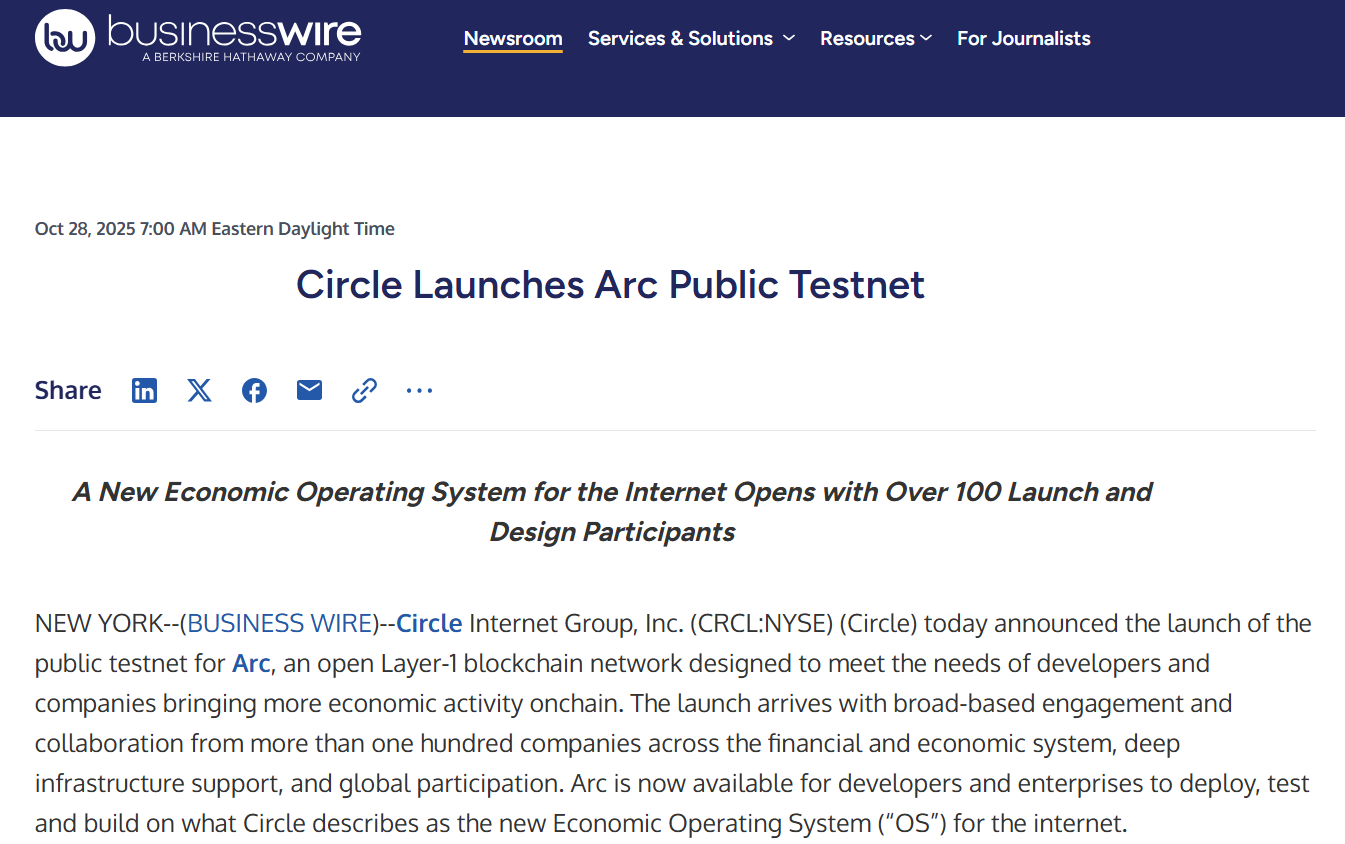
Circle Internet Group has unveiled the public testnet for Arc, a new Layer 1 blockchain designed to power large-scale financial and enterprise applications. Marketed as an “Economic Operating System for the Internet,” Arc is already drawing attention from over 100 major organizations spanning banking, payments, capital markets, and technology.
Among the early participants are some of the world’s leading institutions, including BlackRock, Visa, Anthropic, Amazon Web Services, Mastercard, and Deutsche Bank. The testnet is now live, allowing developers and enterprises to deploy, test, and build on the platform.
Jeremy Allaire, Circle’s co-founder and CEO, described Arc’s early traction as “remarkable,” highlighting its reach across multiple continents.
“These companies collectively move, exchange, and custody hundreds of trillions in assets,” Allaire said. “Arc is built to connect every local market to the global economy.”
Enterprise-Ready Blockchain Infrastructure
Arc is engineered with predictable dollar-based fees, sub-second transaction finality, and optional privacy controls, according to Circle. It also integrates directly with Circle’s existing full-stack platform, which supports global payments, foreign exchange, lending, and capital market activities.
Fresh off a $1.2 billion IPO, Circle introduced Arc in August as a blockchain optimized for stablecoins and tokenized assets. The company, the world’s second-largest stablecoin issuer, currently manages about $76 billion in U.S. dollar-pegged tokens—nearly a quarter of the total market. Analysts at Bernstein have called Circle “well-positioned” to build the dominant stablecoin network through Arc’s infrastructure.
Broad Institutional Engagement
The testnet’s participants represent a who’s who of global finance. Firms in capital markets include Apollo, BNY Mellon, Intercontinental Exchange, and State Street, while major banks and asset managers such as Goldman Sachs, HSBC, Société Générale, and Standard Chartered have also joined.
On the payments and technology side, Cloudflare, FIS, Nuvei, Paysafe, Vodafone’s Pairpoint, and others are exploring how Arc can enable real-time, frictionless payments for businesses. Circle also said Arc could eventually allow autonomous AI systems to exchange and settle value globally.
A Global Stablecoin and Developer Ecosystem
Arc’s testnet supports a wide range of fiat-backed tokens, including AUDF (Australian dollar), BRLA (Brazilian real), JPYC (Japanese yen), KRW1 (South Korean won), MXNB (Mexican peso), PHPC (Philippine peso), and QCAD (Canadian dollar). Circle is working with other issuers to bring additional dollar, euro, and multi-fiat tokens onto the network.
The blockchain’s developer ecosystem is being built in collaboration with infrastructure partners like Alchemy, Chainlink, LayerZero, Thirdweb, and QuickNode, alongside wallet providers such as MetaMask, Fireblocks, Ledger, and Turnkey.
Circle is also partnering with Anthropic, integrating its Claude Agent SDK to offer AI-powered development tools. Cross-chain protocols like Wormhole and Stargate are linking Arc to other blockchains, while exchanges such as Coinbase, Kraken, and Robinhood are participating to strengthen liquidity and market functionality.
Looking Ahead
Circle says Arc is designed to meet both high-performance and regulatory requirements, bridging traditional finance with on-chain innovation. The company’s roadmap includes expanding validator participation and establishing transparent governance to eventually transition Arc toward community-driven operations.
As Allaire summarized, “Arc offers a foundation for every type of company to build on secure, enterprise-grade infrastructure. It’s a step toward a more open, inclusive, and efficient global economy—built directly on the internet.”



