
China Renaissance, once dubbed China’s “M&A King,” is reinventing itself for the digital asset era. The boutique investment bank, known for orchestrating landmark tech mergers, has approved a $200 million allocation to Web3 in 2025—half of which is going directly into BNB, the native token of BNB Chain.
The bold move, structured through a partnership with YZi Labs (formerly Binance Labs), positions China Renaissance as one of the most aggressive traditional finance players betting on crypto.
From M&A Glory to Crypto Strategy
China Renaissance built its reputation by brokering some of China’s biggest internet mergers: Didi with Kuaidi, and Meituan with Dianping. During the country’s internet boom, those deals made it a dominant force in investment banking.
But as China’s growth cooled, antitrust scrutiny rose, and advisory fees fell. By the early 2020s, the firm needed a new path forward. That pivot began after founder Bao Fan’s disappearance in 2023, when his wife Xu Yanqing took over as chairwoman.
Xu rolled out “China Renaissance 2.0,” a strategy anchored in hard tech, digital finance, and Web3. The $200 million allocation, approved in mid-2025, cements that shift.
Why BNB?
In August 2025, the bank signed a memorandum of understanding with YZi Labs to acquire $100 million in BNB, doubling down on an earlier budget for crypto assets. The move quickly drew comparisons to MicroStrategy’s Bitcoin play, with local media calling China Renaissance “Hong Kong’s BNB MicroStrategy.”
Planned initiatives include:
- Structuring BNB-backed investment products with Huaxing and Huaxia Fund in Hong Kong.
- Launching a real-world asset (RWA) fund to promote BNB adoption.
- Supporting BNB’s listing on OSL Exchange, Hong Kong’s licensed crypto trading platform.
At BNB Chain’s fifth anniversary event, Xu said:
“We no longer get asked why digital assets matter. Institutions now want to know how to allocate core assets like BNB correctly.”
The Hong Kong Angle
The timing aligns with Hong Kong’s push to become a digital asset hub, backed by stablecoin legislation and tokenization pilots. Still, hurdles remain. Regulators in the city have shown “low recognition” of listed firms holding crypto on balance sheets, according to Caixin.
Meanwhile, Beijing continues to enforce strict crypto restrictions, making Hong Kong a rare foothold for Chinese firms seeking regulated exposure. Offshore yuan shortages also mean USD- and HKD-backed stablecoins dominate, leaving CNH-pegged tokens sidelined.
Market Context
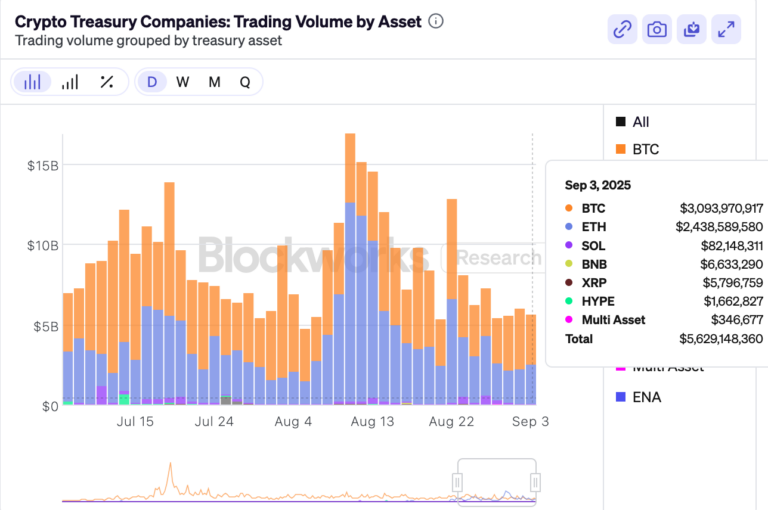
Despite the fanfare, BNB faces an uphill climb in institutional adoption. Data from Blockworks Research (Sept. 3, 2025) showed BTC and ETH account for over $5.5 billion in treasury trading, while BNB’s share was just $6.6 million.
YZi Labs framed China Renaissance’s entry as a turning point, posting on X:
“BNB adoption continues to scale… With @Official_CRSHK leading the initiative, BNB is now entering the core of Hong Kong’s regulated financial markets — a signal of its growing role as both a utility token and an institutional-grade asset.”
High Stakes, High Risks
The Web3 pivot isn’t without danger. Unlike traditional advisory work, crypto investing exposes institutions to volatility, protocol failures, and reputational blowback. Singapore’s sovereign fund Temasek learned this the hard way after its exposure to FTX.
At the same time, global markets are tightening scrutiny on Chinese issuers. Reuters reported Nasdaq plans tougher float requirements and faster delistings of thinly traded stocks—an added challenge for firms like China Renaissance straddling both traditional and digital finance.
The Bigger Picture
For two decades, China Renaissance helped fuel China’s internet economy by connecting startups with capital. Today, it’s trying to replicate that role in decentralized finance.
Whether the bank becomes a bridge between Web2 and Web3 or risks fading into irrelevance depends on how well it manages the volatile world of digital assets—and whether BNB can secure a lasting role in institutional portfolios.



