
The Commodity Futures Trading Commission (CFTC) has filed lawsuits against Illinois, Arizona, and Connecticut, asserting exclusive federal jurisdiction over prediction markets. The action marks the agency’s first direct legal challenge against states in this emerging sector.
The complaints, filed Thursday, follow cease-and-desist orders issued by Illinois authorities against platforms including Kalshi, Crypto.com, and Polymarket. The CFTC argues these entities operate as designated contract markets (DCMs) under federal oversight, and that state-level enforcement attempts violate the Commodity Exchange Act.
Does Federal Authority Override State Gambling Laws?
The dispute reflects a growing regulatory divide between federal derivatives oversight and state gambling frameworks. States have increasingly targeted prediction platforms, particularly those offering sports-related contracts, citing local gaming laws. By contrast, the CFTC maintains these instruments fall within federally regulated swaps markets, not state betting regimes.
This tension has intensified in recent weeks as prediction markets gain traction. Platforms like Polymarket are pursuing multi-billion dollar valuations, while regulators debate classification standards. The CFTC previously supported Crypto.com in a related Nevada case, but Thursday’s filings represent a broader escalation across multiple jurisdictions.
“Illinois’s attempt to shut down federally regulated DCMs intrudes on the exclusive federal scheme Congress designed,” the agency said in its complaint.
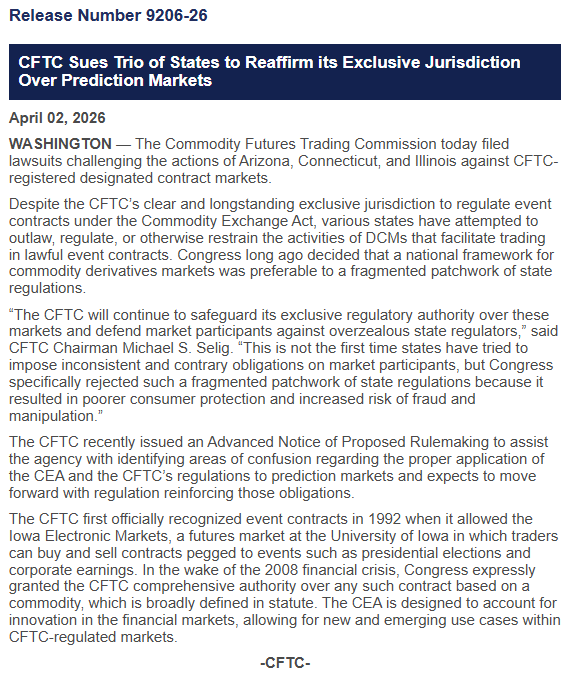
CFTC Chair Michael Selig added that inconsistent state rules risk increased fraud and weaker consumer protections. Could this legal confrontation define how prediction markets are regulated across the United States?
The agency is asking courts to invoke the Supremacy Clause, arguing federal law preempts state enforcement in this domain. It also seeks permanent injunctions preventing states from applying local statutes to federally regulated platforms. State officials have not publicly responded to the filings.
The outcome could establish a precedent for jurisdictional authority as prediction markets expand into mainstream financial infrastructure. The next catalyst will be early court rulings on whether federal derivatives law overrides state-level gaming enforcement.



