

Corporate leaders are pressing ahead with artificial intelligence investments, even as many struggle to show clear, company-wide returns. Reporting from The Wall Street Journal and Reuters suggests most CEOs expect AI spending to keep rising through 2026, despite uneven results and growing pressure to prove value.
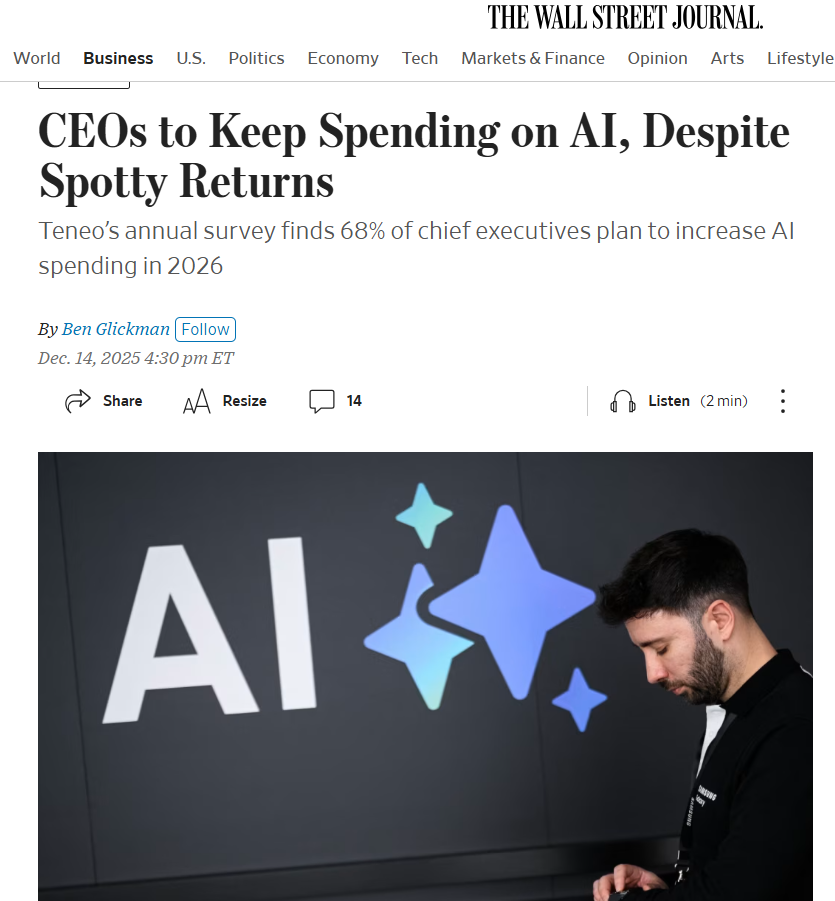
The disconnect reflects where many large organisations now find themselves. AI has moved beyond early experiments, but it has not yet settled into a dependable driver of performance. For many companies, the technology sits in an uncomfortable middle ground: no longer optional, but not yet delivering at scale.
Spending continues, even as payoffs remain uneven
AI budgets across major enterprises have climbed steadily over the past two years. Competitive pressure, board expectations, and fear of falling behind rivals are all pushing leaders to stay the course. At the same time, executives are becoming more candid about what they are and are not seeing.
Benefits often appear in narrow areas rather than across entire organisations. Pilot projects show promise but fail to spread. Integrating AI tools with older systems proves costly and time-consuming. As a result, progress can feel fragmented, even as spending grows.
A Wall Street Journal survey of senior executives found that most CEOs view AI as essential to long-term competitiveness, regardless of near-term uncertainty. For them, AI is no longer treated as a project that can be paused or cut if results disappoint. Instead, it is seen as a capability that must be built over time, much like digital infrastructure in earlier decades.
That mindset helps explain why budgets remain intact. Many leaders worry that pulling back now could weaken their position later, particularly as competitors refine how they use the technology.
Why AI pilots struggle to scale
One of the biggest obstacles to stronger returns is the leap from experimentation to daily use. Many companies have launched AI pilots across departments, often without shared standards or clear coordination. While these trials generate learning and enthusiasm, few lead to changes that reshape core operations.
Reuters reports that efforts to scale AI frequently run into problems with data quality, system integration, security controls, and regulatory compliance. These challenges are not purely technical. They often expose organisational gaps, such as unclear ownership, divided responsibilities, and slow decision-making once legal, risk, and IT teams become involved.
The result is a familiar pattern: significant spending on experiments, with limited progress toward AI systems that are fully embedded in how the business runs.
Infrastructure costs reshape AI strategy
Rising infrastructure costs are also complicating the return on AI investment. Training and running models requires substantial computing power, storage, and energy. Cloud expenses can escalate quickly as usage increases, while building in-house systems demands upfront capital and long planning cycles.
Executives cited by Reuters warn that infrastructure costs can easily outpace early benefits, particularly during the build-out phase. This has forced difficult strategic choices: whether to centralise AI resources or let teams experiment independently, whether to rely on external vendors or develop systems internally, and how much inefficiency is acceptable while capabilities are still taking shape.
In practice, these decisions are shaping AI outcomes as much as the technology itself.
AI governance moves to the centre
As spending rises, scrutiny is increasing. Boards, regulators, and internal audit teams are asking tougher questions about risk, accountability, and value. In response, many organisations are tightening oversight.
According to the Wall Street Journal, companies are shifting away from loosely connected experiments toward clearer goals, defined ownership, and formal timelines. Central AI teams and governance councils are becoming more common, and projects are being linked more directly to business priorities.
This shift can slow decision-making, but it reflects a broader change in how AI is viewed. It is no longer treated as a side initiative. Instead, it is being managed with the same discipline as other major investments.
Expectations are being reset, not abandoned
Continued spending does not mean CEOs are blindly optimistic. Rather, expectations are being adjusted. Leaders are learning that AI rarely produces immediate, sweeping returns. Value tends to emerge gradually, as workflows change, staff are retrained, and data foundations improve.
Instead of scaling back entirely, many organisations are narrowing their focus. They are prioritising fewer use cases, clarifying accountability, and tying projects more closely to measurable outcomes. This recalibration may dampen early excitement, but it increases the chance of sustainable gains.
What this means for 2026 planning
For companies planning ahead to 2026, the message from CEOs is not to retreat from AI, but to approach it with greater discipline. Ownership, governance, and realistic timelines matter more than headline spending figures or bold promises.
The organisations most likely to benefit are treating AI as a long-term shift in how work gets done, not a quick fix for growth. As strategies mature, success will depend less on how much is spent and more on how well AI fits into everyday operations.



