

Researchers from Brave and the National University of Singapore have unveiled a new privacy attack that sheds light on how artificial intelligence models may inadvertently memorize and reveal sensitive data. The technique, called CAMIA (Context-Aware Membership Inference Attack), is the most effective method to date for probing what AI systems “remember” from their training datasets.
Why Memorization Matters
AI models are often trained on vast collections of text, which can include sensitive material. This raises the risk of data leakage—when private information resurfaces in generated content. For example, a healthcare model trained on patient records might accidentally output confidential medical details, or a business model trained on internal emails could expose company communications.
Concerns around data use have intensified after announcements like LinkedIn’s plan to train its generative AI systems with user content, fueling debates about how much personal information might be at risk.
How Membership Inference Attacks Work
Security experts test for these risks using Membership Inference Attacks (MIAs), which attempt to determine whether a specific piece of data was part of a model’s training set. Traditional MIAs look for differences in how a model handles known versus unseen data. If the model behaves more confidently with a certain input, it may suggest memorization.
However, most existing MIAs were designed for simpler classification models and fall short against large language models (LLMs), which generate text word by word. This sequential process means that memorization is not always obvious at the whole-text level.
What Makes CAMIA Different
CAMIA’s breakthrough lies in its ability to measure how an AI’s uncertainty shifts during text generation. By analyzing token-level predictions, it identifies when a model switches from “guessing” to “recalling” specific sequences.
For instance, given the phrase “Harry Potter is…written by…”, an AI can infer the correct continuation through general reasoning, making high confidence a normal outcome. But if the input is just “Harry”, correctly predicting “Potter” with strong confidence is far more likely to indicate memorization of the training data.
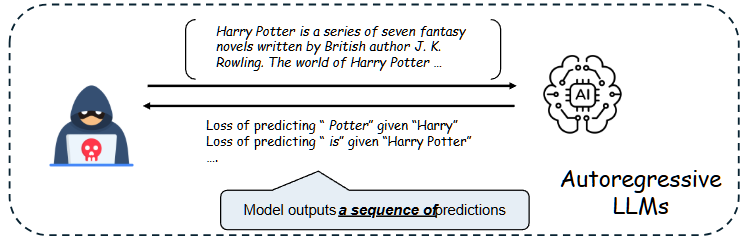
This context-aware approach allows CAMIA to separate genuine generalization from hidden recall, something earlier attacks struggled to achieve.
Stronger and More Efficient
In tests using the MIMIR benchmark on models such as Pythia and GPT-Neo, CAMIA nearly doubled detection accuracy compared to prior methods. On a 2.8-billion-parameter Pythia model trained on the ArXiv dataset, it boosted the true positive rate from 20.11% to 32% while keeping false positives extremely low at 1%.
CAMIA is also efficient. Running on a single A100 GPU, it can process 1,000 samples in about 38 minutes—fast enough to make large-scale audits feasible.
Implications for the AI Industry
The findings highlight an ongoing challenge for AI developers: balancing the utility of large-scale models with the need to protect user privacy. As models grow larger and more complex, so do the risks of hidden memorization.
The researchers behind CAMIA hope their work will encourage the adoption of privacy-preserving techniques and stricter safeguards in training practices. Their results serve as a reminder that while generative AI holds enormous potential, its development must account for the fundamental right to privacy.



