

Bittensor’s native token TAO fell 15% to $285 within two hours after Covenant AI announced its departure. The sharp move highlights market sensitivity to governance disputes within decentralized AI networks.
Covenant AI, a major subnet developer on Bittensor, confirmed Thursday it will exit the ecosystem. Founder Sam Dare said the decision stems from governance concerns, alleging the network no longer operates under meaningful decentralization. The team had built one of the largest decentralized large language model pre-training efforts, known as Covenant-72B, within the network.
— covenant (@covenant_ai) April 9, 2026
Is Bittensor’s Governance Undermining Decentralization Claims?
The dispute centers on control mechanisms within Bittensor’s upgrade process, which operates under a three-party multisig structure. Dare claimed that co-founder Jacob Steeves retains effective control, contradicting the network’s stated design. Governance tensions have become a recurring issue across decentralized AI protocols, where coordination often concentrates among core contributors despite distributed architectures.
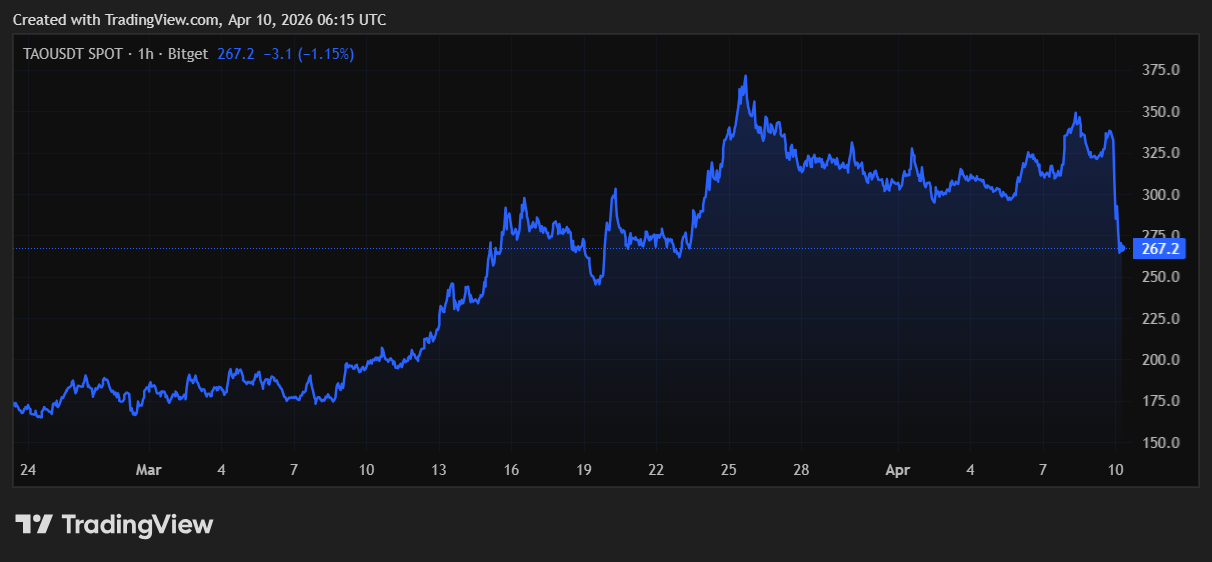
But the market reaction suggests investors are pricing governance risk similarly to other protocol-level disruptions. For comparison, major token drawdowns tied to internal disputes have historically triggered double-digit declines across smaller-cap crypto networks, particularly those reliant on a narrow set of builders.
“It is decentralization theatre,” Dare wrote, alleging unilateral actions including emission suspensions, infrastructure deprecation, and targeted token sales.
He added these measures were “punitive actions taken by one man,” referring to Steeves. The Bittensor co-founder did not directly address the claims but stated the event could lead to “headless” subnets and new ownership models tied to token lockups.
Exploits are what teach a system its weak spots.
— const (@const_reborn) April 10, 2026
The quicker you find them the faster you learn.
The outcome of this eventful evening is that Bittensor will invent lock-based subnet ownership -- specifically: ownership of a subnet determined by a team's long term economic… https://t.co/dUMYXjAmU6
Community response on X was mixed, with some users criticizing Covenant’s abrupt exit and lack of prior communication. Meanwhile, Mark Jefferey, partner at Bittensor Fund, said the network extends beyond a single subnet and that TAO would continue to function independently of Covenant’s departure.
Bittensor is a quite a LOT more than Subnet 3, and $TAO will carry on fine without it.
— Mark Jeffrey (@markjeffrey) April 10, 2026
It's unfortunate that the founder chose this path.
There are 125 other subnets -- plus three new slots that just freed up.
TAO has since partially recovered to $294, but attention now shifts to whether Bittensor can stabilize developer participation and implement proposed governance changes, with upcoming subnet ownership reforms emerging as the next catalyst.



