

Bittensor Expands to 118 Subnets, Fueling Optimism for $1,000 TAO Token Milestone
Decentralized AI network Bittensor continues to gain traction, recently crossing a major milestone with 118 active subnets—its highest to date. The expansion adds fresh momentum to speculation that the TAO token could break the $1,000 price level in 2025, driven by both technical progress and growing institutional interest.
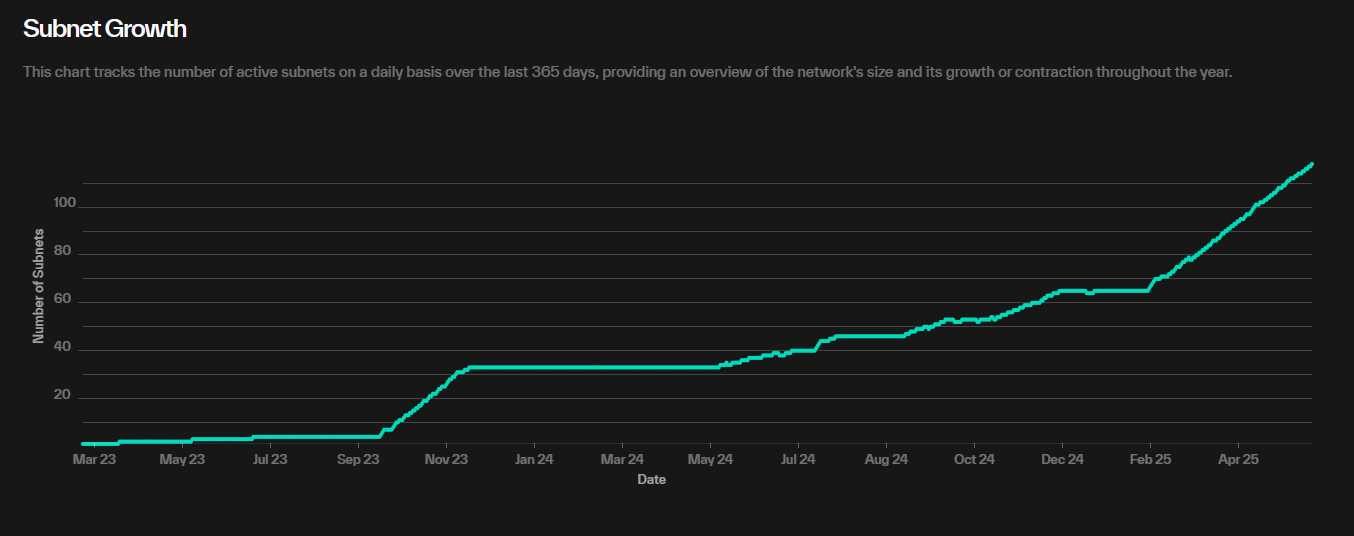
Subnet Growth Signals Decentralized AI Momentum
According to Taostats.io, Bittensor’s subnet count surged to 118 in early June. These subnets act as task-specific environments where developers, data providers, and validators collaborate to build and refine AI models. Each subnet supports unique applications, from natural language processing to real-time data analysis.
The significance? More subnets mean greater adoption of the Bittensor protocol, a diversified set of use cases, and a larger pool of contributors earning rewards in TAO. Under Bittensor’s incentive model, participants are compensated for their work via token emissions, incentivizing innovation and computation power.
While the subnet boom marks a leap forward, it also introduces new technical challenges. Maintaining performance and security across a growing decentralized infrastructure will require constant optimization and governance refinement.
BitGo and Yuma Unlock Institutional Access to TAO Staking
One of the most influential recent developments for Bittensor is its new partnership between BitGo, a well-established digital asset custodian, and Yuma, a top-performing validator on the network. Together, they’ve launched institutional TAO staking, allowing funds and corporate investors to participate in Bittensor while earning passive income through staking rewards.
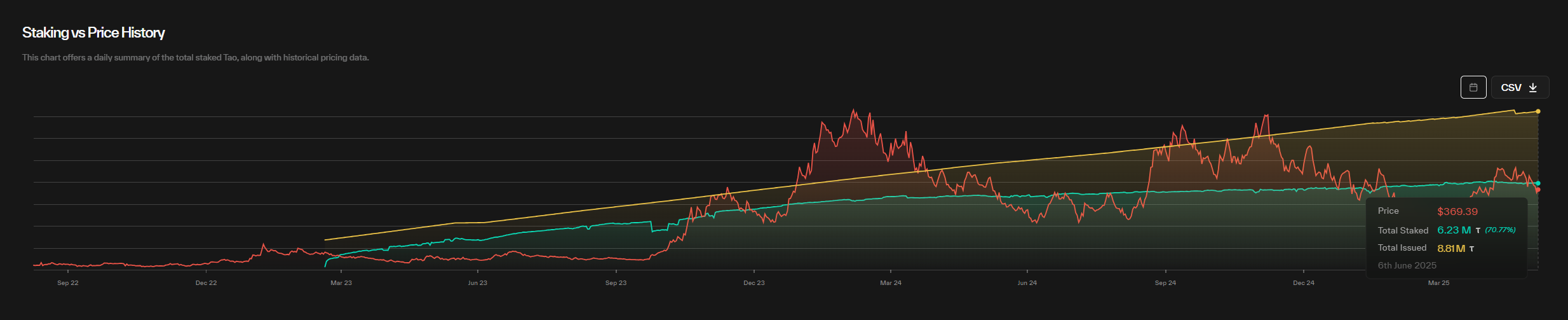
With more than 6 million TAO now staked—over 70% of circulating supply—this move has tightened supply and strengthened long-term holder confidence.
At the same time, the network’s latest technical overhaul, Yuma Consensus 3, introduced smarter fraud detection and a more equitable rewards system for validators and miners. This positions Bittensor as a serious contender in the decentralized AI space, competing with centralized AI platforms through transparent, community-driven mechanisms.
Can TAO Really Hit $1,000?
Price predictions are swirling as Bittensor’s fundamentals continue to improve. Crypto analyst Decode, using Elliott Wave Theory, believes TAO is structurally primed for a major breakout, possibly surpassing the $1,000 threshold.
“You will see a similar structure and bullish setup on many other altcoins, but few are as strong as TAO,” Decode stated.
If you missed it or want to add, a wave structure of 1 into completed 2, followed by a smaller degree impulse 1 into 2, is the perfect Elliott Wave entry. As such I am very interested in adding to Bittensor #TAO here. pic.twitter.com/Kub9AbE7Bd
— Decode (@decodejar) June 5, 2025
Still, caution is warranted. The broader AI crypto sector has cooled significantly, with the total market cap of AI-related tokens sliding from $69 billion at the end of 2024 to just $31 billion now. Investor interest in speculative altcoins remains subdued, even for projects with solid fundamentals.



