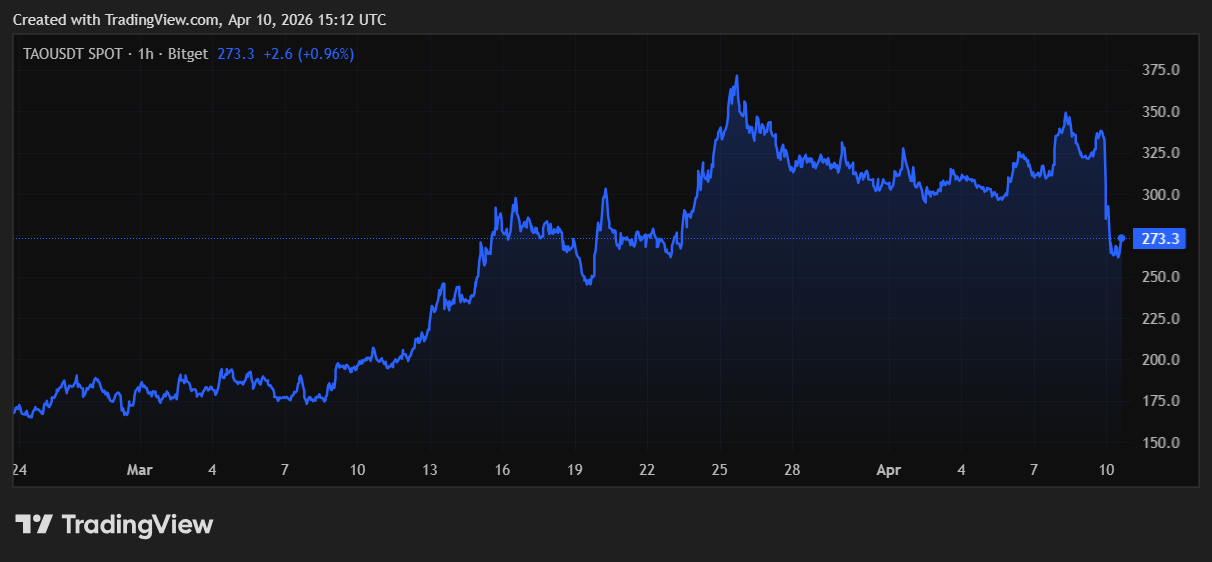
Bittensor’s TAO token dropped 15% within two hours Thursday, falling from $338 to $285 following Covenant AI’s exit announcement. The sharp move highlights how governance disputes in decentralized AI networks can quickly translate into market volatility and erode investor confidence.
The conflict centers on allegations by Covenant AI founder Sam Dare, who accused Bittensor co-founder Jacob Steeves of exerting unilateral control over subnet operations. Dare claimed Steeves suspended emissions, removed moderation access, deprecated infrastructure, and used token sales to apply economic pressure. Steeves denied the allegations in a post on X, stating he lacks authority to alter emissions beyond standard token holder activity.
Btw i should address some of the points in the article which AI slop influencers are now repeating.
— const (@const_reborn) April 10, 2026
> I suspended emissions to his subnets
I do not have the ability to suspend emissions. What i did do is sell some of my alpha holdings on his three subnets, because they were…
Does Bittensor Governance Withstand Centralization Claims?
The dispute lands at a critical moment for decentralized AI networks, where governance credibility underpins both developer participation and capital inflows. Bittensor’s model relies on token-weighted incentives and subnet autonomy, but Dare’s claims of “decentralization theatre” raise questions about enforcement mechanisms. Comparable governance disputes in DeFi have historically triggered prolonged capital outflows and developer exits.
Steeves addressed each claim directly.
“I do not have the ability to suspend emissions,” he wrote, attributing changes to market-driven token activity tied to non-functional subnets running near 100% burn code. On token sales, he added they represented less than 1% of his total investment, noting, “Visibility is impossible to avoid in my position.”
Still, key governance concerns remain unresolved. Steeves did not respond to claims regarding control over the network’s three-person multisig for upgrades, leaving uncertainty around decision-making authority. Yet, he confirmed temporarily restricting Dare’s moderation actions to prevent deletion of critical feedback, later reinstating access.
TAO has since partially recovered to $294 before sliding toward $262, according to data, and remains more than 65% below its April 2024 peak of $757. The next catalyst will likely hinge on whether Bittensor clarifies governance structures or faces further subnet departures that test its decentralized claims.