

Bitdeer Technologies Group returned to profitability in the fourth quarter, posting sharply higher revenue as it expanded its bitcoin self-mining operations. Despite the strong financial turnaround, the company’s shares fell more than 8% following the earnings release.
The Singapore-based crypto mining and infrastructure firm reported nearly $225 million in revenue for the quarter ended Dec. 31, up from $69 million a year earlier. Net income reached $70.5 million, a significant reversal from the $531.9 million loss recorded in the same quarter the previous year.
Self-Mining Drives Revenue Surge
Much of the growth came from Bitdeer’s self-mining business, which generated $168.6 million in revenue during the quarter, compared with $41.5 million a year ago. The company mined 1,673 bitcoins in the final three months of the year, up from 469 in the same period last year.
That increase reflects a rapid expansion in computing power. Bitdeer’s total managed hash rate climbed to 71 exahashes per second (EH/s), more than three times its level a year earlier. Of that total, 55.2 EH/s came from its own self-mining operations, with the remainder tied to machines hosted for customers.
The company’s scale now places it among the largest publicly traded bitcoin miners by computing capacity. On the metric of total managed hash rate, Bitdeer has surpassed competitor MARA Holdings.
At the end of the quarter, Bitdeer held just over 2,000 bitcoin on its balance sheet. However, data from BitcoinTreasuries indicates the company reduced those holdings to around 1,040 BTC in the first two months of 2026. The sales likely supported ongoing capital expenditures, including expanded mining operations and new artificial intelligence infrastructure.


Bitdeer did not immediately respond to a request for comment.
Margin Pressure and AI Pivot
While revenue and profitability improved, margins showed signs of strain. Gross margin declined to 4.7%, down from 7.4% a year earlier. The company cited rising electricity costs and higher depreciation expenses as it deployed new mining rigs at scale.
Operating expenses also increased. Research and development spending rose as Bitdeer continued building out its proprietary SEALMINER chip series and investing in infrastructure aimed at artificial intelligence and high-performance computing clients.
Management has increasingly positioned Bitdeer as more than a bitcoin miner. The company now describes itself as a hybrid operator, combining digital asset mining with data center capacity tailored to AI workloads.
Bitdeer reports approximately 3 gigawatts of global power capacity across active and pipeline projects. Several sites are expected to be partially converted to support AI applications over the next two years, reflecting a broader industry trend of miners diversifying into high-demand computing services.
Market Reaction
Despite the return to profitability, investors reacted cautiously. Bitdeer shares fell more than 8% on Thursday, slipping below $11 and hitting a new year-to-date low, according to price data.
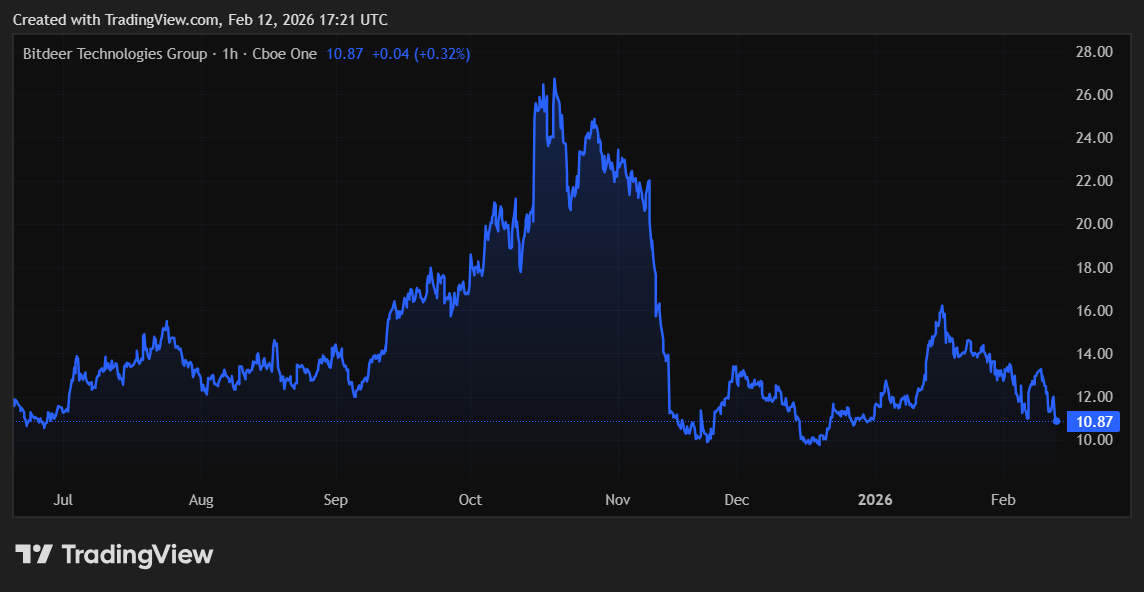
The earnings highlight a company in transition: expanding aggressively in bitcoin mining while simultaneously building a foothold in AI infrastructure. As competition intensifies in both sectors, Bitdeer’s ability to balance growth, costs, and diversification will likely shape its performance in the months ahead.
For now, the fourth-quarter results show that scale can deliver revenue growth, but sustaining profitability in a capital-intensive industry remains a challenge.



