

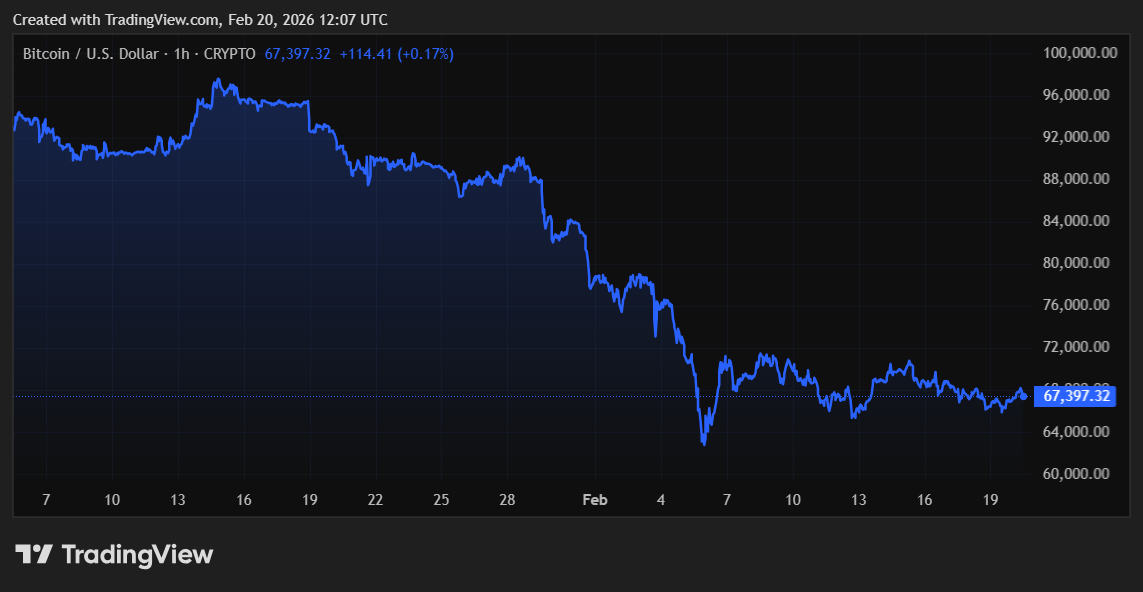
Bitcoin is trading below the $79,000 “True Market Mean,” a key onchain valuation threshold tracked by Glassnode. The breakdown signals a structural shift as exchange-traded fund outflows and tight liquidity remove a steady source of demand.
Glassnode’s latest weekly report shows bitcoin decisively lost the aggregate cost basis of active supply, a level that has historically separated expansion from compression phases. The firm identifies the Realized Price near $54,900 as the lower boundary of the current range, marking the average acquisition cost of all circulating coins. Bitcoin was changing hands around $67,700 at publication, according to price data.
Are ETF Outflows Resetting Bitcoin’s Market Structure?
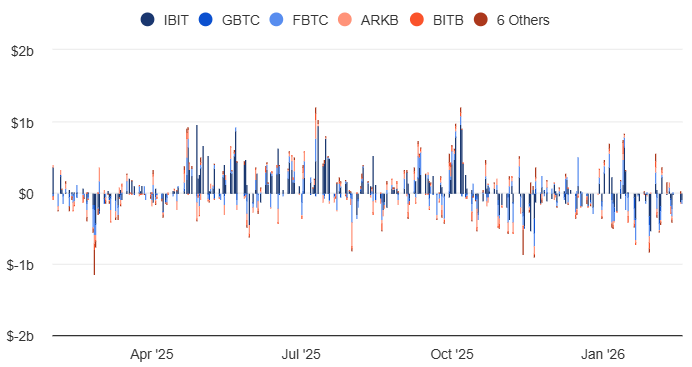
U.S. spot Bitcoin exchange-traded fund net flows have rotated back into sustained outflows, according to Glassnode, reversing what had been a persistent marginal bid. Spot cumulative volume delta across major exchanges also turned negative, pointing to active sell-side pressure rather than thin liquidity alone. The Accumulation Trend Score has improved to roughly 0.4, suggesting distribution has eased, yet conviction from large holders remains limited.
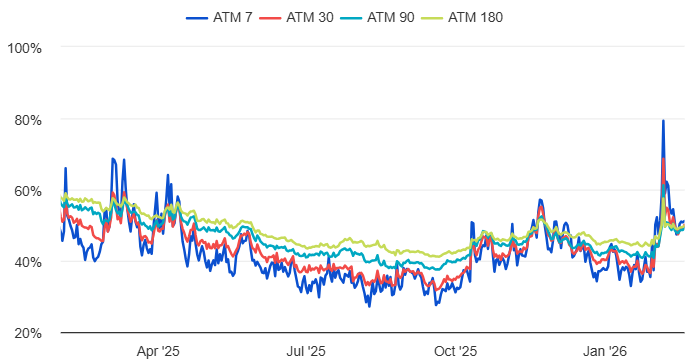
Derivatives data indicates panic hedging has cooled without shifting to bullish positioning. Implied volatility has fallen sharply from recent highs, and 25-delta skew has compressed from extreme levels, signaling traders are unwinding downside protection but not rebuilding upside exposure in size.
“Bitcoin is navigating an adjustment phase amid macroeconomic caution,” said Antonio Di Giacomo, senior market analyst at XS.com, citing resistance near $70,000 and support around $64,000 to $65,000.
Nic Puckrin, co-founder of Coin Bureau, argued that liquidity conditions will determine whether a durable floor forms, pointing to ongoing sell-side pressure in onchain spot volume. He suggested deeper capitulation toward $55,000 to $58,000 remains possible unless ETF inflows resume or the U.S. dollar weakens materially. Minutes from the Federal Reserve’s January meeting reinforced a patient stance on rate cuts, keeping macro constraints in focus. The next catalyst will be whether ETF flows stabilize or the Federal Reserve signals a clearer easing path.



