

Bitcoin fell back to roughly $90,000 on Thursday after the Federal Reserve delivered a widely expected quarter-point rate cut but paired it with guidance that analysts viewed as cautious. The softer tone pushed risk assets lower, reversing a brief upswing that had lifted bitcoin toward $94,500 before the announcement.
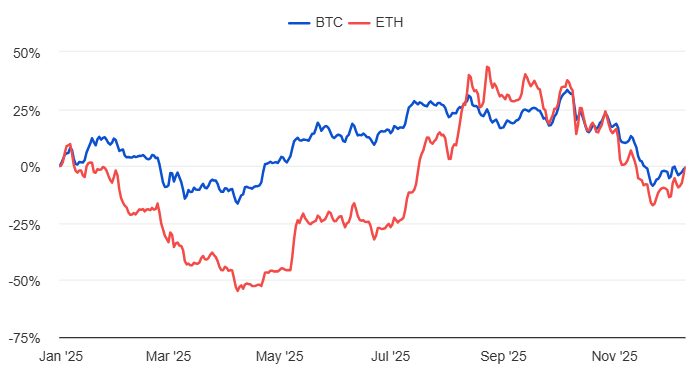
The drop continues a familiar pattern: seven of the last eight Federal Open Market Committee meetings have been followed by bitcoin declines. Ether also slipped below $3,200, and major altcoins weakened across the board. Both BTC and ETH now show negative returns over the past year and year-to-date.
A cut wrapped in caution
Fed Chair Jerome Powell acknowledged signs of a cooling labor market and described the current policy rate as sitting “in neutral territory.” Still, he stressed that future decisions hinge on incoming economic data and said risks remain tilted to the upside for both unemployment and inflation.
The Fed kept its outlook for 2026 unchanged, projecting only one additional rate cut. The 9–3 vote marked the largest number of dissents since 2018, underscoring internal splits at a time Powell called a “very challenging” environment.
Analysts viewed the move as deliberate and measured rather than a shift toward aggressive easing. Several noted that the central bank raised its growth outlook and lowered its inflation expectations, yet also signaled that further cuts will require stronger justification.
Nic Puckrin, co-founder of Coin Bureau, said the decision “wasn’t as hawkish as some expected,” but the limited path for future cuts and the number of dissenting votes add uncertainty.
“This isn’t enough to spark a Santa rally for bitcoin,” he said.
Liquidity support, but no spark for new highs
The Fed also said it will buy $40 billion in Treasury bills over the next 30 days to maintain sufficient reserves, beginning Dec. 12. Officials emphasized this is not quantitative easing, though analysts noted the extra liquidity still offers a tailwind.
Matt Howells-Barby, Kraken’s head of growth, said the mix of a neutral-leaning rate stance and reserve purchases could help crypto markets into early 2026. He warned, however, that the Fed’s upcoming voter rotation may tilt the committee more hawkish, limiting the chances of faster easing.
Paul Howard of Wincent echoed that view, calling the Fed’s posture “wait-and-see.” While any easing is helpful, he said, it is “not enough for new all-time highs this side of Easter.”
ETF inflows steady, but conviction remains thin
Despite the market cooldown, ETF demand remained firm. U.S. spot bitcoin ETFs recorded $224 million in net inflows on Tuesday, with BlackRock’s IBIT drawing $193 million. Ethereum products added $57.6 million, while Solana and XRP funds brought in about $15 million combined.
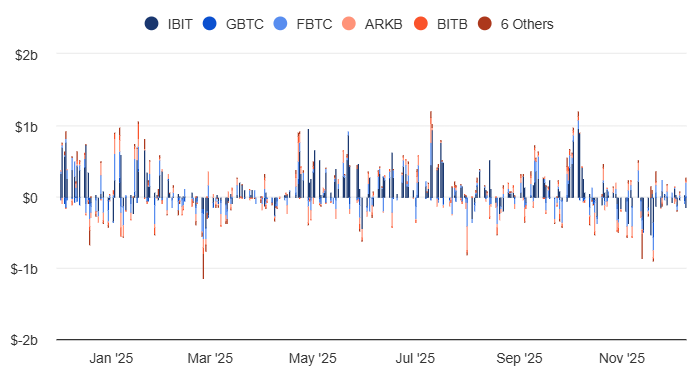
Even so, the price reaction stayed muted. BRN Head of Research Timothy Misir said the downturn reflected a market that “welcomed the cut but not the guidance,” calling the move another example of the “hawkish cut” many traders anticipated. He noted that institutional buyers remain active, accumulating more than 42,000 BTC since Dec. 1, while retail investors continue to trim exposure.
Exchange balances keep falling, suggesting long-term scarcity, but short-term holders are pulling back. Misir said this push-and-pull has kept bitcoin in a tightening trading range.
“The cut is supportive, but conditional,” he added. “Institutions are buying dips while retail sells into stress. The question is whether ETF demand can keep absorbing supply until macro clears.”



