
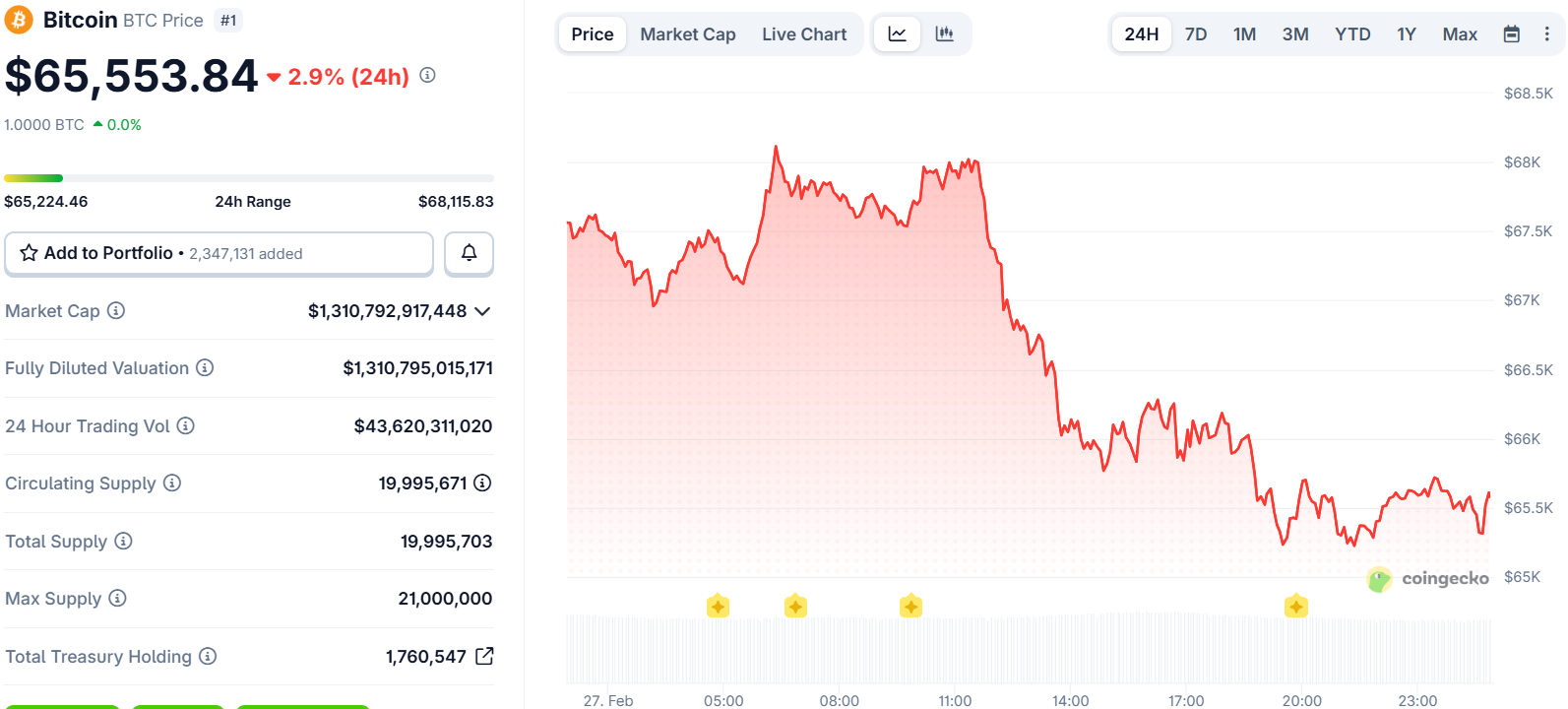
Cryptocurrency markets took a sudden and aggressive hit on February 27. After spending several days attempting to break past the 70,000 USD mark, Bitcoin sharply reversed course and tumbled down to roughly 65,200 USD. This sudden drop was not driven by typical market fundamentals. Instead, a fresh wave of global geopolitical anxiety sparked a widespread selloff. Traders are reacting nervously to escalating United States military posturing in the Middle East and some highly controversial comments from President Donald Trump regarding the future of Cuba.
The political situation in the Caribbean is heating up fast. Speaking earlier today, President Trump openly suggested the possibility of a friendly takeover of Cuba. He told reporters that the Cuban government is in severe trouble and actively negotiating with his administration. To fully grasp this, we have to look back at his recent policies. After returning to office in January 2025, Trump revived maximum pressure tactics against Havana. By late January 2026, he signed an executive order declaring a national emergency and threatened heavy tariffs on any nation supplying oil to the island.
This aggressive stance effectively created a fuel blockade. Because Cuba relies so heavily on imported oil from places like Venezuela and Mexico, the island is now suffering through rolling blackouts and crippling fuel shortages. Tensions spiked even higher this week following a fatal maritime clash. Cuban forces intercepted a United States registered speedboat near their coast, resulting in four deaths. While Havana labeled the crew as armed infiltrators, Washington firmly denied any involvement but has launched an official investigation. The phrase friendly takeover is incredibly sensitive right now, especially for a nation that has defined itself by resisting American influence for over sixty years.
The NY Times admits that the US military has imposed a naval blockade on Cuba.
— Ben Norton (@BenjaminNorton) February 22, 2026
This is an act of war. The Trump admin is illegally seizing any oil tanker that tries to provide fuel to Cuba.
This is a barbaric medieval siege aimed at starving millions of Cubans into submission. pic.twitter.com/dHQnYLdYVI
Simultaneously, anxiety is mounting in the Middle East. The United States has visibly bolstered its military presence in Israel due to rising friction with Iran. Washington has deployed advanced fighter jets to the region, and the State Department recently authorized the departure of all nonessential diplomatic staff. While government officials categorize these moves as standard deterrence, global financial markets view them as massive red flags indicating severe geopolitical risk.
🚨🇮🇱🇺🇸 11 of these beasts landed in Israel, U.S. F-22 Raptor jets
— Mario Nawfal (@MarioNawfal) February 24, 2026
This is significant
It's the first time in history the U.S. deploys fighter jets to Israeli soil for an operational, combat-oriented mission rather than joint exercises or trainingpic.twitter.com/FIPwAgkWo7
So, how does this all tie back to your digital wallet? When international stability gets shaky, investors traditionally panic and dump riskier assets. Data tracked by CoinGecko shows Bitcoin losing over 3 percent of its value in just 24 hours as liquidity quickly tightened. The crypto market often reacts to these macro shocks in two distinct phases. First, we see the immediate price crash as people seek safety in cash. However, if the geopolitical instability drags on, a second phase often occurs where investors rotate back into Bitcoin, treating it as an independent hedge against traditional financial systems.
For now, we are firmly stuck in that fearful first phase. With simultaneous pressure campaigns unfolding in both the Middle East and the Caribbean, market volatility is virtually guaranteed to stay high. The next major move for Bitcoin will depend entirely on whether diplomatic channels can cool things down or if these global conflicts escalate further.



