

Vancouver city staff concluded Bitcoin cannot legally be held in municipal reserves. The determination blocks a proposal to diversify city funds into the cryptocurrency.
The recommendation follows a legal review of the Vancouver Charter, the provincial law governing municipal operations. Staff submitted the report to the Vancouver City Council this week, advising the council to rescind a motion introduced in November 2024 that aimed to make Vancouver a “Bitcoin-friendly” city.
Mayor Ken Sim had proposed allocating a portion of municipal reserves into Bitcoin to preserve purchasing power during inflationary cycles. The council approved a feasibility study in December 2024 and directed staff to report back by the first quarter of 2025.
Can Municipal Governments Hold Bitcoin Reserves?
City staff said the Vancouver Charter restricts investment options for municipal reserves and does not classify Bitcoin as a permitted asset.
“Staff has conclusively determined that under the Vancouver Charter, Bitcoin is not an allowable investment asset for the City,” the report stated.
The proposal also faced resistance from provincial authorities. According to CBC, the British Columbia Ministry of Municipal Affairs previously warned that local governments are not permitted to hold financial reserves in cryptocurrencies because of exposure to “undue risk.”
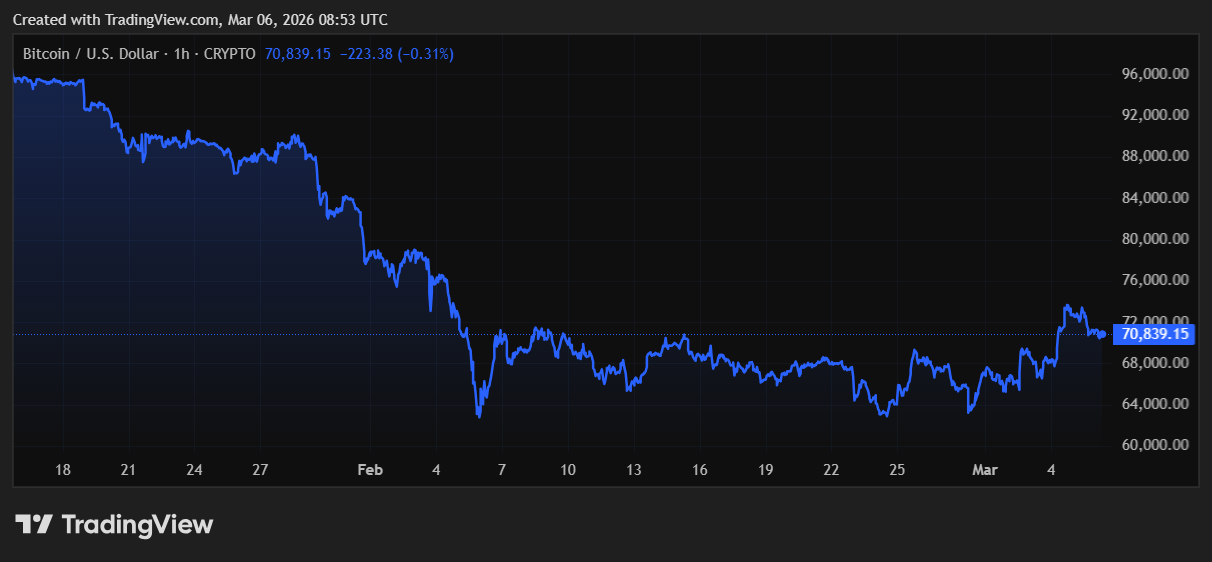
The debate reflects broader institutional caution around digital assets despite rising adoption in private markets. Bitcoin reached an all-time high above $126,000 in recent months before dropping roughly 50% to near $63,000 within four months. The asset currently trades near $70,166, according to data.
Mayor Sim had framed the initiative as a hedge against currency debasement and inflation, calling Bitcoin “the greatest invention in human history” and pledging to donate $10,000 worth of the cryptocurrency to the city. Still, municipal staff also cited competing priorities and resource allocation as reasons to halt further work.
The council must now decide whether to formally terminate the initiative. Yet the broader question remains: will regulatory frameworks adapt if more municipalities explore digital assets as treasury holdings?
For now, Vancouver’s proposal highlights a key barrier to public-sector crypto adoption. The next catalyst may come from provincial lawmakers if legal definitions of municipal investment assets are revisited.



