

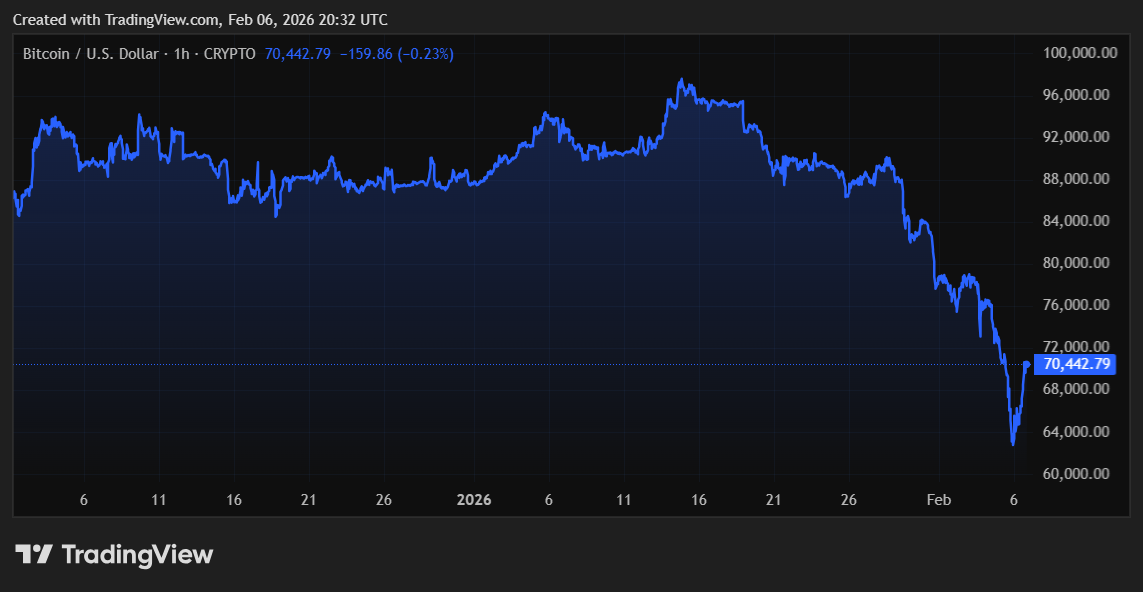
Bitcoin has just recorded its steepest two-week decline since June 2022, dropping more than 50% from its October high and reigniting debate over whether the worst of the selloff may already be behind it.
According to Bitwise Chief Investment Officer Matt Hougan, the recent downturn reflects a mix of familiar forces rather than a single shock. In a note to investors published Friday, Hougan said long-term holders have been selling aggressively, largely in anticipation of bitcoin’s historically observed four-year cycle. He estimates that well over $100 billion worth of bitcoin was sold by long-term investors last year as fears grew that the market was approaching another post-peak drawdown.


That selling pressure was compounded by leverage liquidations and a broader shift away from risk assets. As investors grew more cautious, capital moved out of crypto and into other areas, including artificial intelligence-linked equities earlier in the year and, more recently, precious metals. Hougan described this rotation as a pullback by “attention investors” who tend to chase momentum across asset classes.
A macro-driven pullback, not a crypto crisis
Bitcoin’s slide has not happened in isolation. Other risk assets have also struggled, with U.S. equities facing pressure amid uncertainty around economic growth, interest rates, and capital spending. Even traditional safe havens like gold and silver have seen sharp selloffs.
Hougan argues this context matters. Unlike 2022, when the crypto market was rocked by high-profile collapses and structural failures, the current drawdown does not show signs of forced selling tied to insolvency or broken infrastructure. In his view, crypto is responding to broader macro stress rather than internal weaknesses.
“This time is different” is a phrase often viewed with skepticism in markets, but Hougan believes there are meaningful distinctions. While he acknowledged that bitcoin could still fall further and noted that past downturns have sometimes been deeper and longer, he also pointed to signs of market maturity that reduce the likelihood of a repeat of the chaos seen two years ago.
Sentiment near historic lows
Crypto market sentiment is now hovering near levels last seen at major bottoms in 2018 and 2022. That, according to Hougan, suggests much of the negative news may already be reflected in prices.
“Crypto bear markets tend to end in exhaustion, not excitement,” he wrote, framing the current environment as one where sellers may be running out of momentum rather than one driven by fresh panic.
Bloomberg senior ETF analyst Eric Balchunas echoed that long-term perspective, noting that both stocks and bitcoin have historically recovered from sharp drawdowns to reach new all-time highs. While he conceded that markets can always surprise, he emphasized that past selloffs alone have not derailed bitcoin’s broader trajectory.
For people who trade it's a dif story they are trying to time all this up and down amid the beatdown-ATH march, but their inconvenient truth is that it is very difficult, expensive and spiritually-consuming way to live and almost all will go broke or at the very best make money…
— Eric Balchunas (@EricBalchunas) February 6, 2026
A tentative bounce, but volatility remains
After touching a low near $60,000, bitcoin has shown signs of stabilizing, rebounding to reclaim the $70,000 level and gaining nearly 4% on the day. Still, the bigger picture remains mixed. Bitcoin is down roughly 35% over the past year, underscoring the scale of the recent correction.
For now, investors are left weighing near-term uncertainty against longer-term patterns. While caution remains warranted, the growing view among some market watchers is that the most intense phase of selling pressure may be easing.



