

Bitcoin has become the focal point of institutional crypto activity in 2025, driving a sharp rise in blockchain-related disclosures across U.S. regulatory filings. New data shows that mentions of blockchain and digital assets in filings with the Securities and Exchange Commission climbed steadily throughout the year, reaching roughly 8,000 references by August and staying elevated through November.
At the center of that growth is Bitcoin. Mentions tied specifically to Bitcoin accounted for the largest share of the increase, reflecting how traditional finance firms are concentrating their crypto strategies around the most established digital asset. The trend follows the successful launch of multiple spot Bitcoin exchange-traded funds in early 2024, which opened the door for asset managers to offer regulated Bitcoin exposure at scale.
Throughout 2025, those firms continued to expand their offerings. That expansion showed up in SEC paperwork as new filings, amendments, and disclosures tied to Bitcoin-linked products. Compared with previous cycles, the pattern looks notably different. Mentions of initial coin offerings and broad cryptocurrency references have risen and fallen over time, but Bitcoin-related filings have remained consistently high.
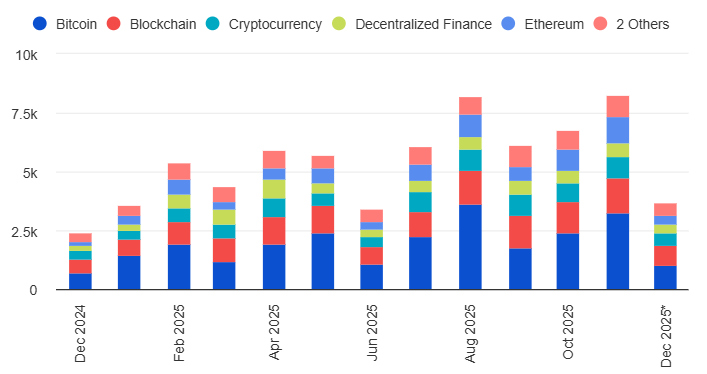
This sustained focus suggests that institutions see Bitcoin as the clearest regulatory entry point into the digital asset market. Rather than spreading activity across a wide range of tokens or experimental models, firms appear to be aligning around assets and structures that regulators already understand and accept.
Regulatory progress has played a major role in shaping that behavior. In early 2025, the United States enacted the GENIUS Act, a comprehensive framework for stablecoin regulation. The law established strict requirements, including full reserve backing, robust anti-money laundering compliance, and monthly public disclosures. It also introduced a dual regulatory model, allowing larger issuers to operate under federal oversight while providing state-level options for issuers with under $10 billion in assets.
While the GENIUS Act focused on stablecoins, its impact extended beyond that segment. By clarifying expectations and compliance standards, it reduced uncertainty for market participants across the digital asset space. Firms gained a clearer sense of how regulators view onchain activity, which lowered the perceived risk of formal engagement.
That momentum continued in July, when the U.S. House passed the Digital Asset Market Clarity Act. The legislation built on the FIT21 framework introduced in 2024 and aimed to define broader market structure rules for digital assets. Together, these measures provided more predictable pathways for registration, reporting, and oversight.
As a result, companies that had previously taken a cautious or exploratory approach began to formalize their operations. Increased regulatory certainty encouraged firms to move from informal experimentation to fully disclosed, compliant activity, a shift that naturally shows up in SEC filings.
The surge in Bitcoin mentions is therefore less about short-term market excitement and more about structural change. Institutions appear to be responding to clearer rules by committing resources, products, and disclosures to assets that fit within established regulatory boundaries.
Looking ahead, the data suggests that Bitcoin will likely remain the anchor of institutional crypto engagement, at least in the near term. As lawmakers continue to refine digital asset policy, filing trends may offer an early signal of where traditional finance sees viable, compliant opportunities onchain.



