

Bitcoin suffered a sharp sell-off late Thursday, briefly sliding to $60,000 and rattling market confidence after failing to hold key support levels. The move marked Bitcoin’s lowest price since September 2024 and capped a volatile 24-hour period that saw the world’s largest cryptocurrency drop about 17% before partially rebounding.
According to price data, Bitcoin hit $60,000 around 7:20 p.m. ET before recovering to roughly $64,100. Ethereum followed a similar path, falling to as low as $1,750 and later trading near $1,899. The sudden swings underscored a broader bout of instability across the crypto market.
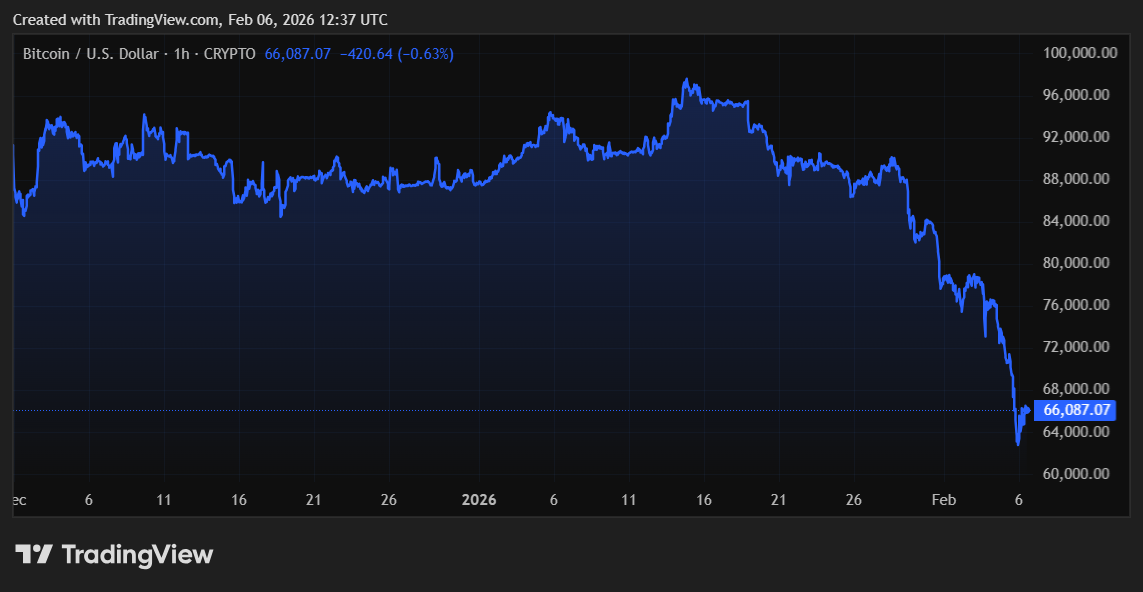
The sell-off triggered a wave of forced liquidations. Data from Coinglass shows roughly $817 million in positions were liquidated over a four-hour window, while total liquidations over the past day reached $2.67 billion. Long positions accounted for the bulk of that figure, at approximately $2.31 billion, highlighting how heavily leveraged bets amplified the downturn.
Market sentiment deteriorated quickly. CoinMarketCap’s Crypto Fear and Greed Index dropped to a reading of 5, placing it firmly in “extreme fear” territory and marking its lowest level since the index was introduced in mid-2023.
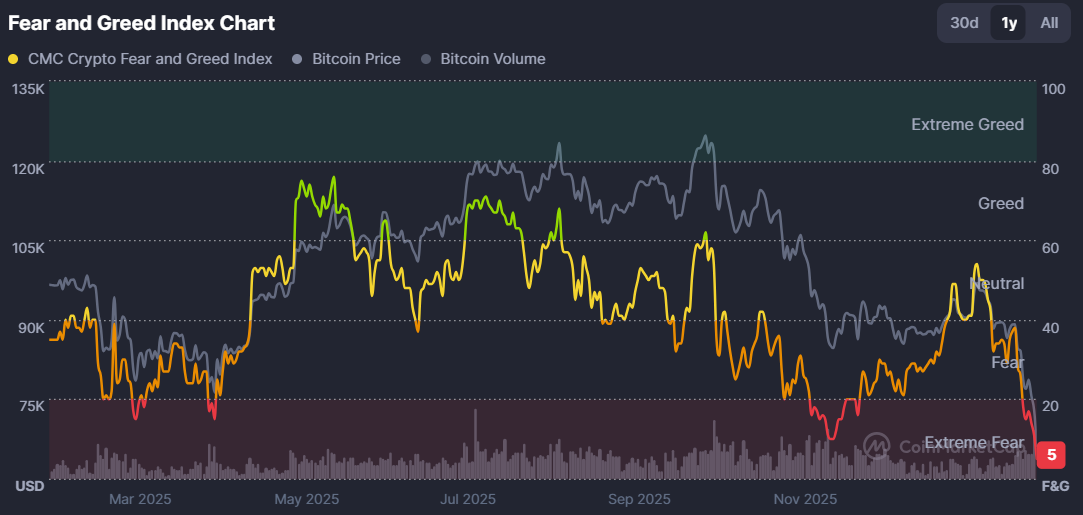
Analysts describe the decline as the result of several pressures converging at once. Vincent Liu, chief investment officer at Kronos Research, said the move reflected a classic leverage unwind driven by overextended long positions, institutional outflows from Bitcoin exchange-traded funds, and a broader shift toward risk aversion in global markets. He noted that Bitcoin’s capitulation metric recently recorded its second-largest spike in two years, signaling intense forced selling.
Traders, meanwhile, appear to be changing their approach. Rachael Lucas, a crypto analyst at BTC Markets, said participants are increasingly focused on preserving capital rather than buying dips. In her view, repeated failures to defend support levels have pushed traders to wait for clearer confirmation before re-entering the market, reinforcing short-term downward pressure. Rallies, she added, are being sold into quickly, while trading volume fades once liquidation-driven activity subsides.
Institutional investors are also pulling back in the near term. Spot Bitcoin ETFs recorded more than $800 million in net outflows across Tuesday and Wednesday, suggesting that even longer-horizon players are reducing exposure amid uncertainty.
Still, analysts caution against reading the move as a collapse in long-term belief. Lucas said broader conviction has not disappeared, but short-term positioning has clearly reset. Historically, such periods tend to flush out weaker hands while longer-term holders remain largely in place.
Looking ahead, Liu said Bitcoin needs to hold the $58,000 to $60,000 range to lay the groundwork for a potential recovery. Any rebound, he added, is likely to depend on price stabilization and supportive news catalysts, and will take time to confirm after the recent turbulence.



