

U.S. spot Bitcoin exchange-traded funds (ETFs) posted $296 million in net outflows for the week ending March 27, reversing a recent inflow trend. The shift erased momentum in institutional demand and pushed total net assets down 7.5% to $84.8 billion, according to SoSoValue data.
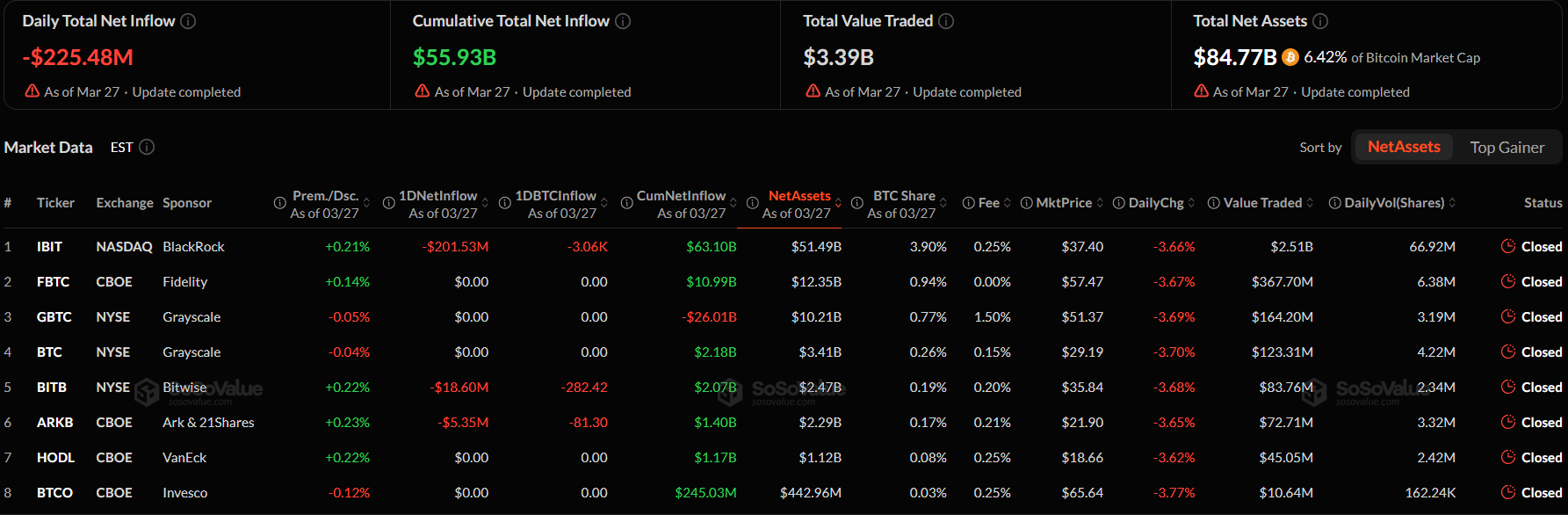
The drawdown was driven by a sharp $225.5 million outflow on March 27 alone, marking the heaviest single-day withdrawal of the week. BlackRock’s iShares Bitcoin Trust led declines with $201.5 million in outflows during that session. The pullback coincided with Bitcoin retracing from above $71,000 to around $65,000 before stabilizing near $67,376.
Are Macro Pressures Driving ETF Outflows?
Globally, digital asset investment products recorded $414 million in net outflows, ending a four-week inflow streak, according to CoinShares. The bulk of redemptions came from the United States, which accounted for $445 million in outflows, while Germany and Canada posted inflows of $21.2 million and $15.9 million, respectively. The divergence suggests selective dip-buying outside the U.S. market.
CoinShares Head of Research James Butterfill attributed the reversal to rising macro uncertainty, including prolonged geopolitical tensions tied to the Iran conflict and shifting rate expectations. June Federal Open Market Committee (FOMC) forecasts have moved from anticipated cuts to potential hikes, pressuring risk assets broadly. But does this signal a structural pause in institutional crypto allocation or a short-term reaction to macro volatility?
Ethereum investment products led losses with $222 million in outflows, pushing year-to-date flows to negative $273 million, the weakest among major assets. Bitcoin-focused funds also saw $194 million in global outflows for the week, though they remain positive year-to-date with $964 million in net inflows. Short-bitcoin products attracted modest inflows of $4 million, indicating some hedging activity.
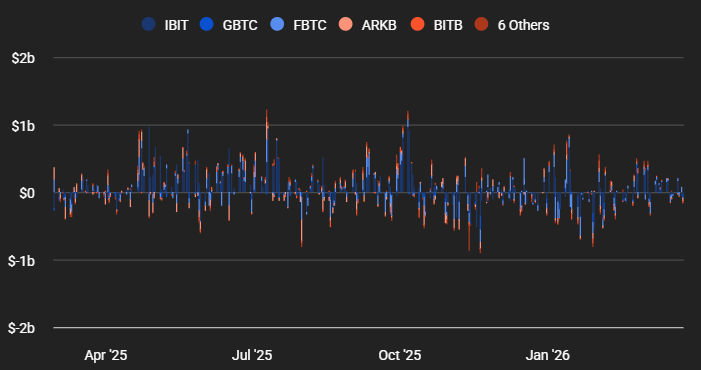
Total assets under management across global crypto funds declined to $129 billion, returning to levels last seen in early February and comparable to April 2025 during initial tariff-related volatility. The contraction reflects a broader cooling in institutional positioning after recent price swings.
Still, the next catalyst will hinge on upcoming macro data and Federal Reserve signaling, which could determine whether ETF flows stabilize or extend their reversal.



