

U.S. spot bitcoin exchange-traded funds recorded $471.3 million in net inflows on Monday, the highest single-day total in six weeks. The surge signals renewed institutional demand through regulated investment vehicles after a volatile start to 2026.
Data from SoSoValue shows inflows were concentrated across six funds, led by BlackRock’s iShares Bitcoin Trust (IBIT) with $181.9 million and Fidelity’s Wise Origin Bitcoin Fund (FBTC) with $147.3 million. ARK 21Shares Bitcoin ETF (ARKB) added $118.7 million, while products from Grayscale, Bitwise, and VanEck also posted positive flows. The inflows reversed $173.7 million in outflows recorded on April 1.
Are Institutional Flows Signaling A Market Shift?
Monday’s total marks the strongest inflow day since Feb. 25, when spot bitcoin ETFs attracted $506 million. The rebound follows March’s $1.32 billion in net inflows, the first positive monthly figure this year after earlier redemptions. Spot Ethereum ETFs also saw $120.2 million in inflows, their largest since mid-March, indicating broader institutional re-engagement across crypto assets.
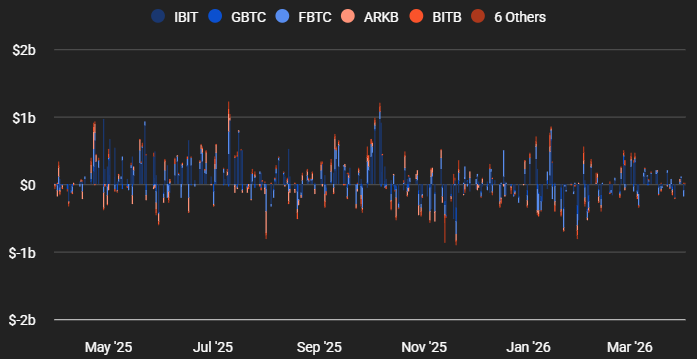
“This reflects renewed institutional confidence through regulated channels following March's strong $1.32 billion monthly inflows,” said Andri Fauzan Adziima, research lead at Bitrue.
Analysts view these flows as structural demand rather than short-term positioning, though macro conditions remain a limiting factor.
Still, geopolitical risk continues to weigh on sentiment across both crypto and traditional markets. Escalating tensions between the U.S. and Iran have disrupted global energy markets, with the closure of the Strait of Hormuz driving oil price volatility and risk-off positioning.
“The current crypto market reflects a healthy consolidation phase transitioning into renewed bullish momentum,” said Nick Ruck, research director at LVRG.
He added that sustained ETF inflows and improved regulatory clarity could support further upside once macro pressures ease. The next catalyst will be whether inflows persist through ongoing geopolitical uncertainty, particularly as institutional allocators reassess exposure amid shifting macro conditions.



