

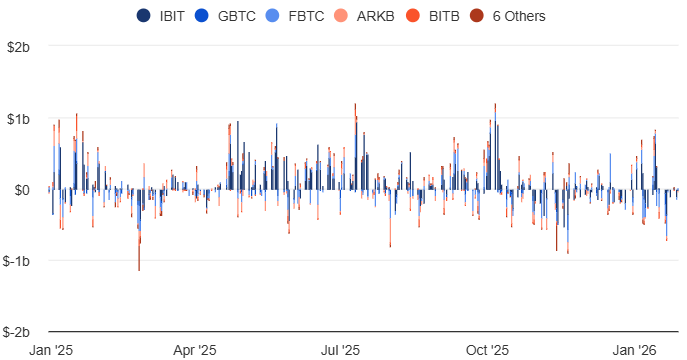
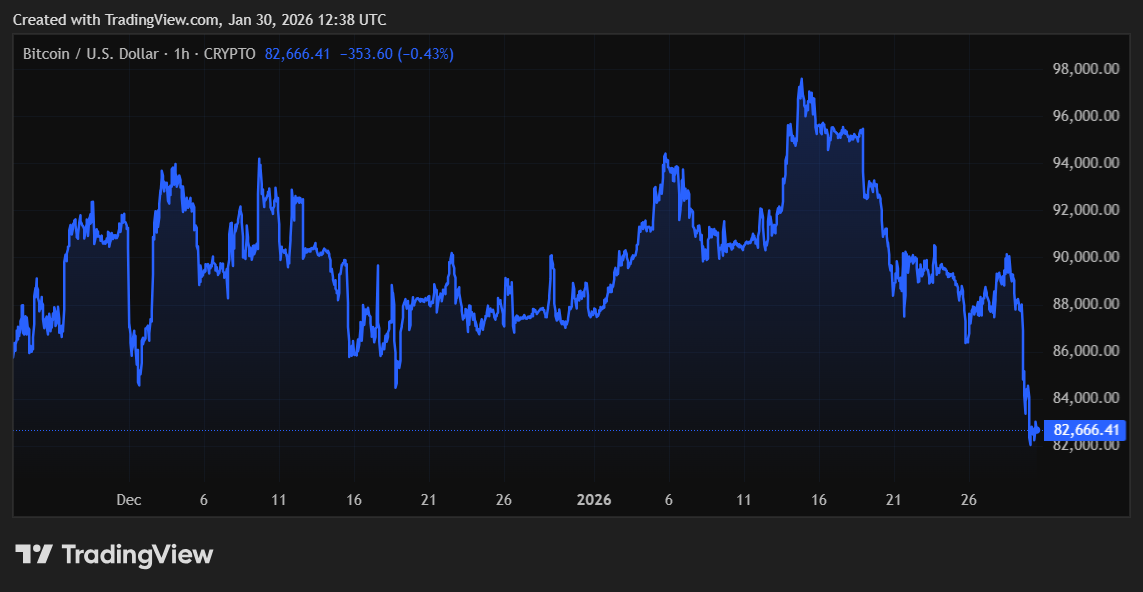
Bitcoin slipped to its lowest level since November on Friday, extending a broad market pullback that has picked up momentum since the U.S. Federal Reserve opted to keep interest rates unchanged this week. The world’s largest cryptocurrency briefly fell to around $81,200 before stabilizing, as U.S. investors withdrew more than $1 billion from major crypto exchange-traded funds in a single day.
The move underscored a sharp shift in sentiment across digital assets. Spot ETFs tied to bitcoin, ether, solana, and XRP all posted net outflows on Thursday, according to data from SoSoValue. The withdrawals came as markets reassessed risk following the Federal Open Market Committee’s signal that it is in no hurry to begin easing policy. While crypto initially absorbed the Fed’s decision calmly, selling pressure intensified alongside declines in equities and commodities.
Bitcoin was down about 3% on the day, with losses spreading across the broader crypto market. Ether and solana both recorded notable drawdowns, mirroring bitcoin’s weakness. Forced liquidations added to the pressure, as more than $1.8 billion in leveraged positions were wiped out over the past 24 hours, largely affecting traders betting on higher prices, according to CoinGlass.
The retreat has not been limited to crypto. Gold has also seen a sharp reversal, falling nearly 7% and erasing an estimated $4 trillion from its market value. Even so, bullion has significantly outperformed bitcoin over the past year, rising roughly 82% compared with bitcoin’s approximate 20% decline over the same period.
By early Friday, bitcoin had recovered modestly to trade above $82,600 ahead of the U.S. market open. Still, the asset remains on track for its fourth straight monthly loss. If confirmed, it would mark bitcoin’s longest losing streak since 2018, when the market was emerging from the post-ICO downturn.
Market participants point to tightening liquidity as a key factor behind crypto’s underperformance. Thomas Perfumo, global economist at Kraken, said that while interest rates often draw attention, they are only part of the picture.
“Global liquidity, the factor with the greatest influence on crypto market performance, remains tight,” Perfumo said.
He added that gold has benefited from a softer U.S. dollar and continues to attract investors looking to reduce risk exposure. Perfumo also noted that bitcoin’s growing role as an institutional asset has reduced the extreme volatility that once appealed to retail traders, though he stressed this dynamic may not be permanent. Clearer U.S. market-structure legislation and stabilization among long-term holders could eventually support renewed interest in digital assets.
Short-term positioning has also played a role. Matt Howells-Barby, vice president at Kraken and a professional trader, said broader risk markets entered the week heavily tilted toward risk-taking. Concerns about heavy artificial intelligence spending by major technology firms unsettled that stance, spilling over into crypto.
“With credit spreads already extremely tight, markets were firmly risk-on going into this move,” Howells-Barby said. “Bitcoin has felt the impact, with a wave of long liquidations pushing prices lower. A failure to reclaim the $83,500 area would leave the $80,000 region in focus.”
Additional pressure has come from within the bitcoin network itself. A weekly report from CryptoQuant highlighted recent strain on miners following a severe U.S. winter storm that forced several large operators to scale back production. The disruption led to bitcoin’s largest hashrate decline since October 2021, with network hashrate falling about 12% from mid-November levels.
As prices weakened and block production slowed, daily mining revenue dropped to a yearly low near $28 million, further squeezing miner profitability. While network data shows that block times and hashrate have begun to recover as weather conditions improve, the episode added another layer of stress to an already fragile market.
Taken together, the recent pullback reflects a convergence of macro uncertainty, tight liquidity, and sector-specific challenges. While bitcoin has shown some signs of short-term stabilization, investors appear cautious as they weigh policy signals, market positioning, and underlying network health. For now, the market’s focus remains on whether digital assets can regain footing or if further volatility lies ahead.



