

A powerful winter storm sweeping across the United States has temporarily slowed the Bitcoin network, after extreme weather conditions prompted large-scale mining operations to reduce electricity consumption to support strained power grids.
The storm, known as Fernan, has brought severe cold, snow, and ice to wide areas of the country, knocking out power for more than one million people and triggering conservation alerts from grid operators. As a result, many Bitcoin miners have curtailed activity, taking a sizable portion of the network’s computing power offline.
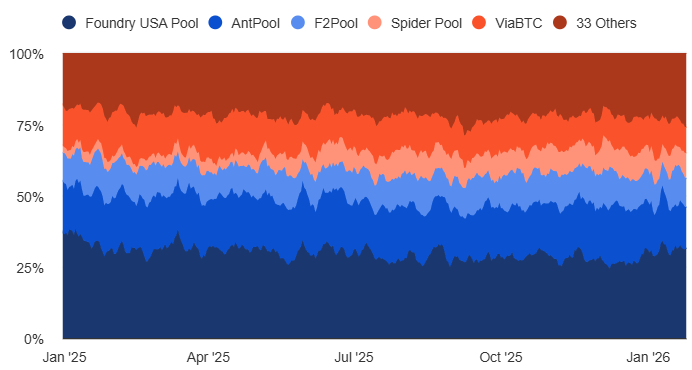
Foundry USA, the world’s largest Bitcoin mining pool by hashrate, has been among the most affected. Since Friday, its connected computing power has dropped by around 60%, falling from a recent high near 328 exahashes per second (EH/s) to roughly 139 EH/s, according to data from miningpoolstats.stream. Foundry represents about 23% of global mining pool market share, making the decline particularly noticeable at the network level.


Other U.S.-focused mining pools have reported similar pullbacks. Luxor’s hashrate fell from approximately 45 EH/s to around 26 EH/s over the same period, while smaller declines were observed at Antpool and Binance Pool. Altogether, an estimated 200 EH/s of computing power has gone offline across the Bitcoin network.
When large amounts of hashrate drop suddenly, Bitcoin blocks take longer to produce. Network data shows average block times rising to about 12.4 minutes, above the protocol’s 10-minute target. In response, Bitcoin’s automated difficulty adjustment is now projected to reset downward by roughly 15%, a built-in mechanism designed to restore normal block production after sustained changes in mining power.
The slowdown reflects a growing trend in how Bitcoin miners interact with energy markets. Many large operations now act as flexible or interruptible power users, participating in demand-response programs that allow them to shut down equipment, avoid peak pricing, or even sell power back to the grid during emergencies. In return, miners often receive compensation or energy credits, helping stabilize electricity systems during periods of stress.

This approach marks a shift from earlier grid crises. During Texas’s February 2021 Winter Storm Uri, large-scale crypto mining played a much smaller role in grid management. Since then, Texas and other regions have added significant flexible load capacity, much of it tied to Bitcoin mining and data centers designed to ramp energy use up or down quickly.
Similar weather-driven disruptions have occurred before. In early 2024, mining activity fell by roughly 25% during large curtailments in Texas, and more recent cold snaps have already led to temporary negative difficulty adjustments on the Bitcoin network.
For now, the impact appears temporary. Once weather conditions improve and miners bring equipment back online, hashrate is expected to rebound and block times to normalize. However, industry observers note that this flexible-load model could face limits in the future, particularly as some mining operators expand into artificial intelligence and high-performance computing, workloads that are typically less tolerant of sudden shutdowns.
In the short term, the episode highlights Bitcoin mining’s evolving role as both an industrial energy consumer and a buffer during periods of grid stress, with network slowdowns serving as a visible reminder of how closely digital infrastructure and physical power systems are now linked.



