

Most crypto investors track charts, technical indicators, or even global money supply to predict Bitcoin’s next big move. But there’s another factor quietly steering the market: central bank liquidity.
Recent analysis suggests that changes in central bank balance sheets may explain Bitcoin’s price swings more accurately than global M2 money supply — and the implications for long-term cycles are striking.
How Liquidity Cycles Shape Bitcoin’s Price
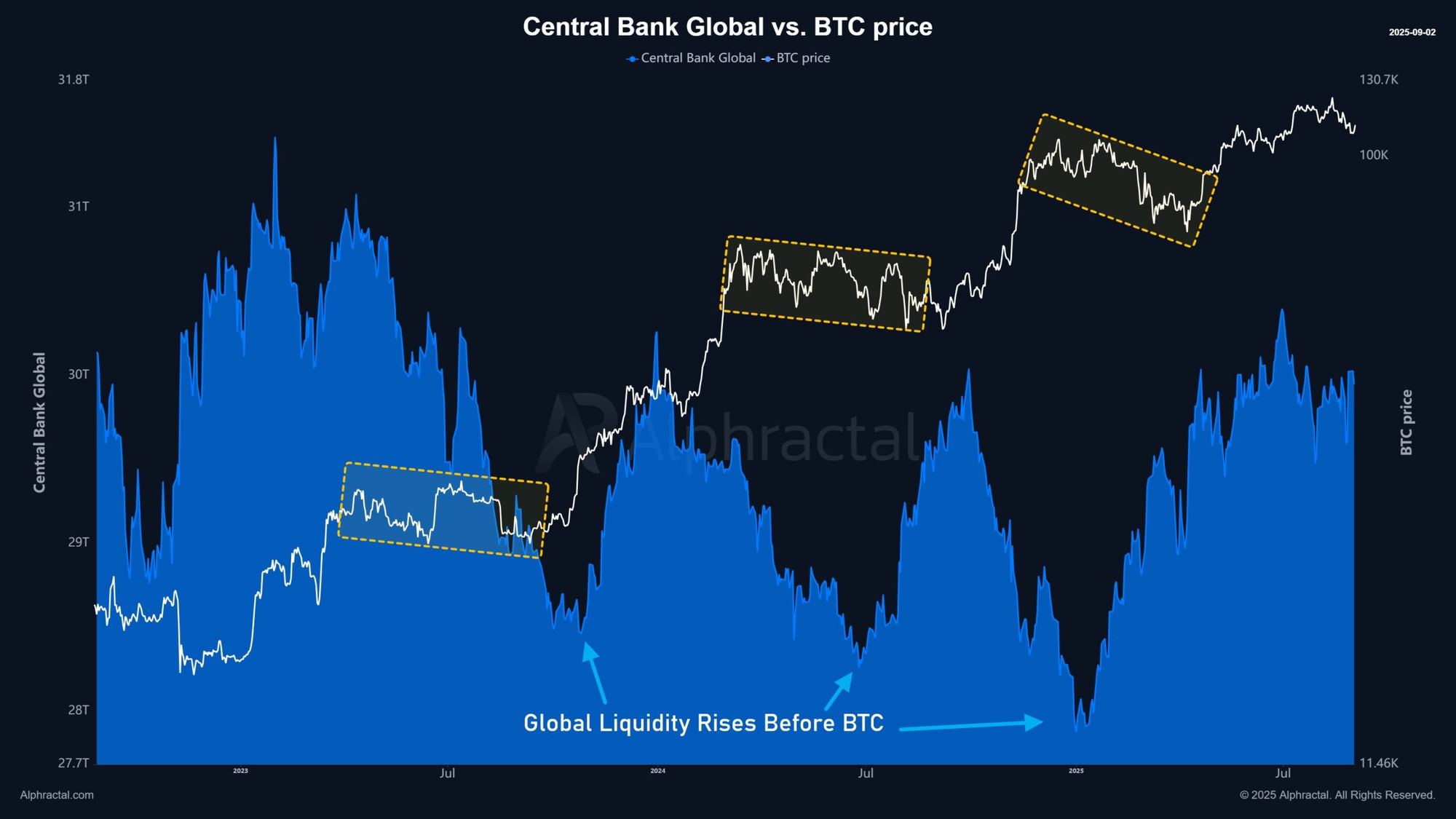
Research by market analyst Alphractal shows that central bank liquidity — the money injected into the financial system by institutions like the Federal Reserve, the European Central Bank, and the Bank of Japan — tends to flow into risk assets such as stocks, gold, and crypto.
Between 2023 and 2025, global liquidity moved in four distinct expansion-and-contraction cycles, fluctuating between $28 trillion and $31 trillion. Each time liquidity expanded, Bitcoin followed with a rally roughly two months later.
“Global central bank liquidity tends to rise before BTC. When liquidity is in its final stage of decline, BTC usually drifts sideways. In other words, central banks inject money first, and part of that liquidity later migrates into risk assets—like BTC,” Alphractal explained.
This correlation helps explain Bitcoin’s recent fluctuations between $100,000 and $120,000 in Q3 2025, as global liquidity has stabilized just below $30 trillion.
Zooming out, analyst Quinten points out that Bitcoin’s four-year halving cycle has lined up neatly with the four-year liquidity cycle since 2020 — adding another layer of evidence that liquidity is a key driver of Bitcoin’s long-term rhythm.
The Debt Problem: A Fragile Foundation
But there’s a catch. Not all experts agree that liquidity alone explains Bitcoin’s path forward.
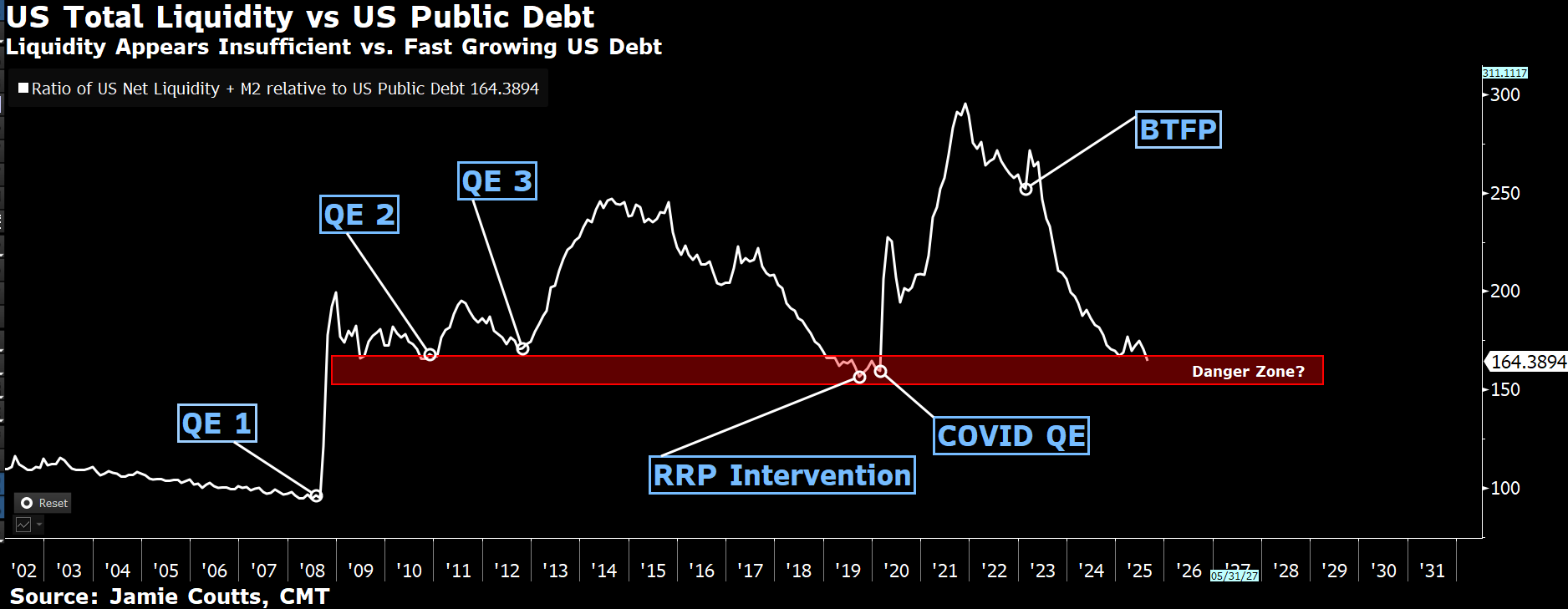
Jamie Coutts, Chief Crypto Analyst at RealVision, warns that rising global debt may undermine the system. He describes liquidity as a “constantly refinancing machine” that needs to grow in tandem with debt. If debt outpaces liquidity — as is already happening in the US — it raises systemic risks for financial markets.
His analysis shows the liquidity-to-debt ratio has fallen to troubling levels. When this ratio is high, extra liquidity fuels inflation. When it’s low, funding pressures rise and risk assets like Bitcoin become vulnerable.
“This doesn’t mean the cycle has ended,” Coutts noted. “But it does signal fragility.”
Ray Dalio’s Warning on Debt and Crypto’s Opportunity
Legendary investor Ray Dalio echoes this concern. He’s repeatedly warned that US public debt has reached unsustainable levels and could trigger what he calls an “economic heart attack” within the next three years.
Dalio suggests that assets with limited supply — including Bitcoin — could become increasingly attractive if the dollar weakens under the weight of excessive debt.
Why This Matters for Bitcoin Investors
Taken together, these perspectives highlight two forces shaping Bitcoin’s future:
- Liquidity Cycles: History shows that central bank liquidity injections often precede Bitcoin rallies by a few months.
- Debt Fragility: If debt growth outpaces liquidity, the financial system could face new stress — creating both risks and opportunities for crypto.
While analysts differ on the exact timing, there’s broad agreement that Bitcoin sits at the crossroads of monetary policy and macroeconomics. For long-term investors, tracking central bank liquidity may prove just as important as following halving cycles or technical charts.



