

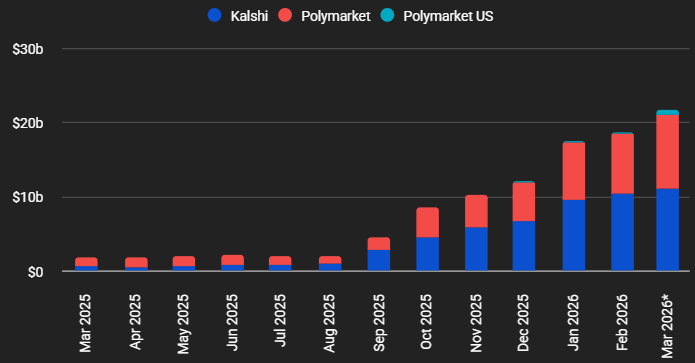
Prediction markets have exceeded $20 billion in monthly trading volume, drawing major crypto exchanges into the segment. Binance’s latest test signals further convergence between trading platforms and event-based speculation tools.
The exchange is piloting an in-app prediction market feature within Binance Wallet through a partnership with Predict.fun, a protocol built on BNB Smart Chain. Users will access event contracts via a separate prediction account, distinct from spot trading balances. The feature remains in beta, with no confirmed launch timeline or jurisdictional scope.
How Will Binance Integrate Prediction Markets In Wallet?
The integration aggregates third-party liquidity, allowing users to trade outcome shares priced between $0.01 and $0.99. Each price reflects the implied probability of real-world events, including elections, sports, and cultural outcomes. This structure mirrors existing decentralized platforms but embeds access directly within a major exchange wallet interface.
Yet Binance is not entering in isolation. Coinbase expanded U.S. access to prediction markets through Kalshi earlier this year, while Crypto.com introduced its own standalone platform ahead of Super Bowl LX. Combined volumes from Kalshi and Polymarket exceeded $20 billion monthly, with March figures reaching $10.98 billion and $10.04 billion respectively, according to data dashboard.
“We are beta testing in-app access to on-chain prediction markets through a third-party integration,” a Binance spokesperson said.
The company added that the feature broadens wallet functionality, with further announcements pending official rollout plans.
Still, regulatory scrutiny is intensifying as volumes scale. U.S. lawmakers recently proposed restrictions targeting sports-linked and casino-style prediction contracts, raising questions about compliance pathways across jurisdictions. Will integrated exchange distribution accelerate adoption faster than regulators can respond?
The next catalyst will hinge on Binance’s formal launch parameters, including supported regions and compliance design, alongside whether competitors expand similar wallet-native prediction infrastructure.



