

Barclays has taken a fresh step into the digital assets space by acquiring a stake in Ubyx, a U.S.-based startup focused on stablecoin settlement infrastructure. The move signals the British bank’s growing interest in exploring how tokenized money can operate within established regulatory frameworks, according to a Reuters report published Wednesday.
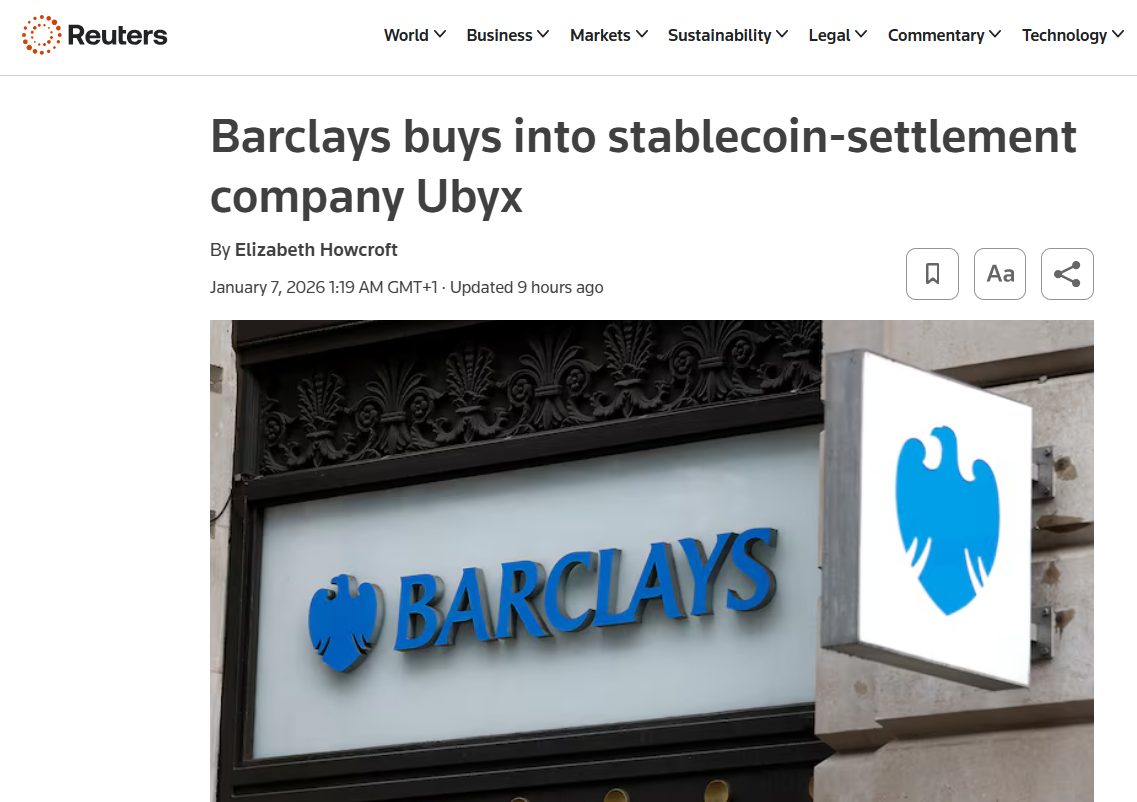
While Barclays did not disclose the size of its investment or the valuation of the deal, the bank confirmed that the decision aligns with its broader strategy to engage with new forms of digital money. In particular, Barclays said it plans to work with Ubyx on developing “tokenized money within the regulatory perimeter,” underscoring a cautious and compliance-driven approach rather than a rush into direct stablecoin issuance.
What Ubyx does and why it matters
Founded in 2025, Ubyx builds infrastructure designed to clear and reconcile transactions across different stablecoin issuers. As the stablecoin market grows more fragmented, such systems aim to make settlement smoother and more interoperable, especially for institutional users.
The startup has attracted notable backing. In July, Ubyx announced a $10 million seed funding round led by Galaxy Ventures, with participation from Coinbase Ventures, Founders Fund, and VanEck. Adding to its institutional credibility, former Commodity Futures Trading Commission commissioner Brian Quintenz joined the company as an adviser last month. Quintenz’s nomination to lead the CFTC was withdrawn last fall, but he remains a well-known figure in U.S. financial regulation.
Two months ago, we released the Ubyx Whitepaper. Today, we announce a $10M seed round led by Galaxy Ventures, with participation from Coinbase Ventures, Founders Fund, VanEck, and industry stakeholders to deliver the global clearing system that will unlock stablecoin ubiquity. pic.twitter.com/XT8QwSxRlL
— Ubyx (@ubyx_) June 17, 2025
Neither Barclays nor Ubyx offered further comment beyond what was reported.
A broader shift toward bank-led digital money rails
Barclays’ investment comes amid a wider push by traditional banks to build shared infrastructure for tokenized money, rather than launching standalone crypto products. In October, Barclays joined a consortium of nine major institutions, including Goldman Sachs and UBS, to explore the creation of a regulated stablecoin pegged to a basket of G7 currencies.
In Europe, a similar initiative is already underway. Last September, nine banks — ING, UniCredit, KBC, Danske Bank, DekaBank, SEB, CaixaBank, Banca Sella, and Raiffeisen Bank International — announced plans to form a new company to issue a euro-denominated stablecoin compliant with the EU’s Markets in Crypto-Assets Regulation (MiCAR). Reuters reported that the Amsterdam-based venture is targeting a launch in the second half of 2026.
Together, these efforts suggest that banks are increasingly focused on shared platforms and regulatory alignment as they test how digital money could fit into the existing financial system.
Stablecoins continue to grow, banks remain cautious
The timing reflects the rapid expansion of stablecoins globally. Total stablecoin supply has now surpassed $290 billion, based on data. Tether’s USDT dominates the market, accounting for roughly $187 billion, or more than 64% of total supply. While stablecoins are still primarily used for settlement and liquidity within crypto markets, their role in cross-border payments is steadily increasing.
Despite this growth, only a small number of banks have issued stablecoins so far. Société Générale’s crypto unit, SG-FORGE, launched a euro-backed stablecoin in 2023, which currently has about €67.8 million in circulation. It followed up with a U.S. dollar-backed token last year, with roughly $26.9 million outstanding. Major U.S. lenders such as Bank of America and Citigroup have said they are studying stablecoin issuance but have yet to release their own tokens.
Barclays, for its part, has chosen a more indirect route. Rather than issuing a stablecoin, it has focused on infrastructure investments and consortium participation. At the same time, the bank has maintained a cautious stance toward retail crypto exposure. In June, Barclays blocked cryptocurrency purchases made with credit cards, citing concerns around volatility and fraud. Other UK banks, including Lloyds Bank and Chase UK, have taken similar measures in recent years.
Looking ahead
By backing Ubyx, Barclays appears to be positioning itself for a future where tokenized money plays a larger role in payments and settlement, but under clear regulatory oversight. The investment reflects a broader trend among global banks: experimenting with digital assets through infrastructure and partnerships, while keeping risk controls firmly in place. For now, it is another sign that traditional finance is steadily, if carefully, laying the groundwork for a more digital form of money.



