

Aster has reduced its monthly token emissions by 97%, shifting to a staking-only distribution model for its native token ASTER. The change sharply limits new supply entering circulation, a move aimed at addressing dilution concerns and stabilizing token dynamics.
The perpetual futures decentralized exchange (DEX), backed by Binance founder Changpeng Zhao, said ecosystem tokens will now be released exclusively as staking rewards. Previously, 78.4 million ASTER—about 1% of total supply—unlocked monthly under a linear schedule. Under the new model, emissions fall to roughly 1.8 million to 2.25 million tokens per month, distributed across weekly epochs.
[Important Notice] Tokenomics Update: Restructuring Ecosystem Emissions
— Aster 🥷 (@Aster_DEX) March 30, 2026
We are replacing the monthly Ecosystem unlock with a staking-only emission model, significantly reducing the amount of $ASTER entering circulation each month.
Previously, 78.4M $ASTER (~1% of max supply)…
Can Reduced Emissions Support Token Value Stability?
The update follows community feedback calling for tighter supply controls and comes alongside an existing buyback program that allocates up to 80% of daily platform fees toward repurchasing tokens. Combined, these mechanisms could shift ASTER toward a deflationary profile, depending on platform activity and staking participation rates.
Token supply remains capped at 8 billion, with over 80% allocated to the community through airdrops and ecosystem incentives. This distribution model mirrors broader trends in decentralized finance (DeFi), where protocols increasingly adjust tokenomics post-launch to balance growth incentives with long-term sustainability. But will lower emissions translate into stronger user retention or simply reduce short-term liquidity?
“Previously, 78.4M ASTER was unlocked monthly on a linear schedule,” the team said, noting that the revised structure ties rewards directly to staking engagement.
The platform also operates a dual reward system that scales incentives based on lock duration and trading activity, aligning user behavior with liquidity provision.
The shift comes as onchain perpetuals trading volumes have cooled following a surge late last year, increasing pressure on platforms to refine incentive structures. Aster recently launched a zero-knowledge (ZK)-powered Layer 1 network to compete with rivals such as Hyperliquid and Lighter, both of which operate on custom chains.
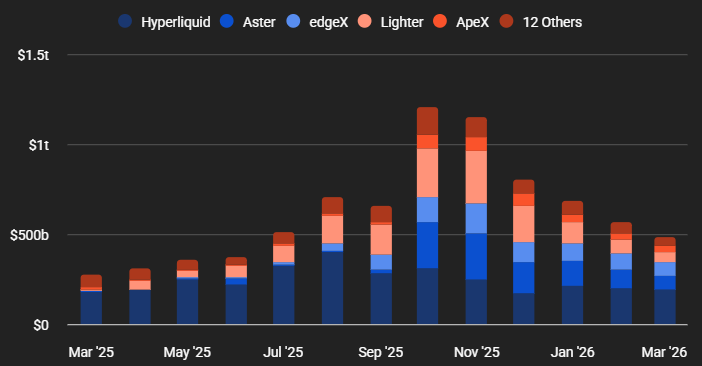
Still, the next catalyst will depend on whether reduced token supply and staking incentives can sustain trading volume and liquidity as competition intensifies across onchain derivatives markets.



