
Apple is making its foundational artificial intelligence (AI) model available to third-party developers for the first time, marking a notable shift in its long-standing closed ecosystem. Announced during this week’s Worldwide Developers Conference (WWDC), the move gives developers direct access to the on-device large language model powering Apple Intelligence, the company's AI suite embedded across its platforms.

This three-billion parameter model runs entirely on-device, aligning with Apple’s privacy-first philosophy, but it also underscores the company’s cautious and technically constrained approach to generative AI—especially when compared to more powerful, cloud-based tools from rivals like OpenAI, Google, and Meta.
“We’re opening up access for any app to tap directly into the on-device, large language model at the core of Apple,” said Craig Federighi, Apple’s senior VP of software engineering, during the WWDC keynote.
Apple’s Foundation Models Framework: Privacy Meets Usability
Apple's new Foundation Models framework allows developers to integrate Apple Intelligence into apps with just three lines of Swift code. The tools come with guided generation, tool-calling capabilities, and support for privacy-respecting AI inference—all available at no cost.
Early adopters include Automattic, the company behind WordPress, which is already using the framework in its Day One journaling app.
“Now we can bring intelligence and privacy together in ways that deeply respect our users,” said Paul Mayne, head of Day One.
Xcode 26 and AI-Powered Developer Tools
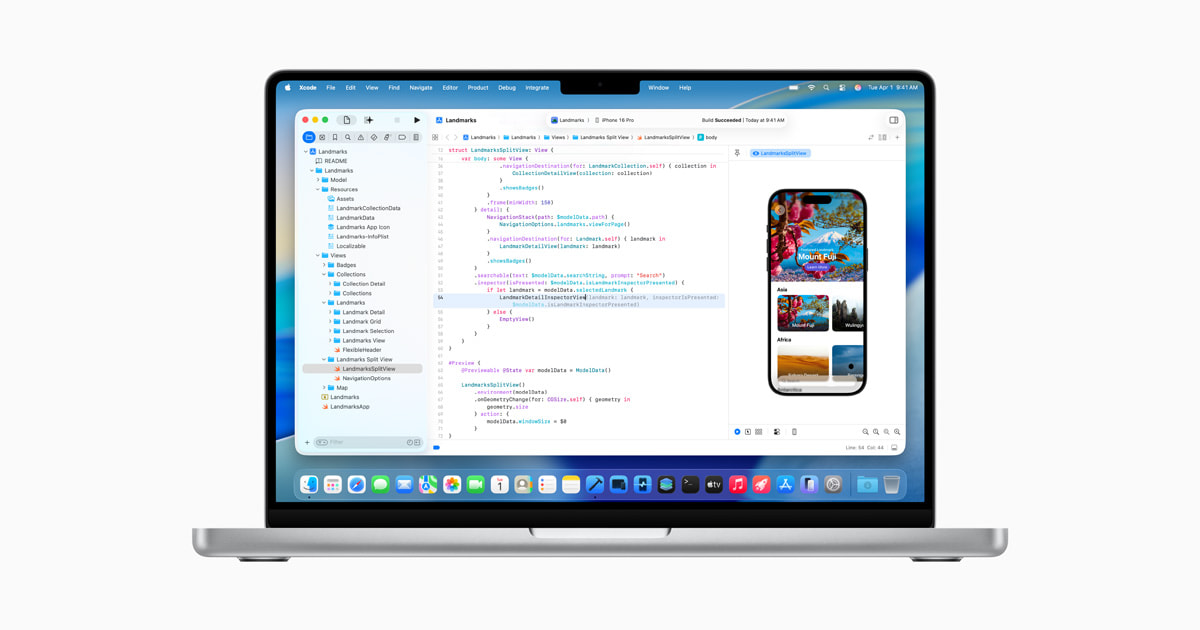
With Xcode 26, Apple has embedded generative AI directly into the coding experience. Developers can now use built-in AI suggestions without signing up for external services. The IDE supports Apple’s own models, ChatGPT, and other third-party integrations via API keys, providing more flexibility than ever before.
The new Coding Tools feature can suggest actions, generate previews, fix issues, and build playgrounds, all within the Xcode interface—bringing generative assistance closer to where developers work.
Apple also extended Visual Intelligence to third-party developers via enhanced App Intents. These tools enable apps to integrate with Apple’s camera-based visual search experience. For example, Etsy is testing the features to boost product discovery, with CTO Rafe Colburn noting its potential for deeper, native engagement: “The ability to meet shoppers right on their iPhone with visual intelligence is a meaningful unlock.”
Despite these technical updates, Apple’s stock dipped 1.2% after the conference, as some analysts viewed the announcements as modest.
“In a moment in which the market questions Apple’s ability to take any sort of lead in the AI space, the announced features felt incremental at best,” said Thomas Monteiro, senior analyst at Investing.com.
Others noted that Apple has shifted its focus from visionary forecasts to delivering stable, privacy-preserving tools.
“They went from being visionary and talking about agents… to now realizing they need to deliver on what they presented a year ago,” said Bob O’Donnell of Technalysis Research.
The three-billion parameter model powering Apple Intelligence reflects both privacy commitments and hardware limitations. While local inference protects user data, it restricts the model’s capacity to handle more complex or open-ended tasks that require broader compute power.
“You could see Apple’s priority is what they’re doing on the back-end,” said Ben Bajarin, CEO of Creative Strategies. “Most people don’t care about that yet.”
Apple’s AI developer tools are now available via the Apple Developer Program, with a public beta coming next month. While some critics may find Apple’s AI rollout underwhelming compared to flashier industry peers, the company’s focus on sustainable, privacy-grounded AI infrastructure suggests a long-term bet: one that prizes control, safety, and usability over headline-grabbing breakthroughs.



