
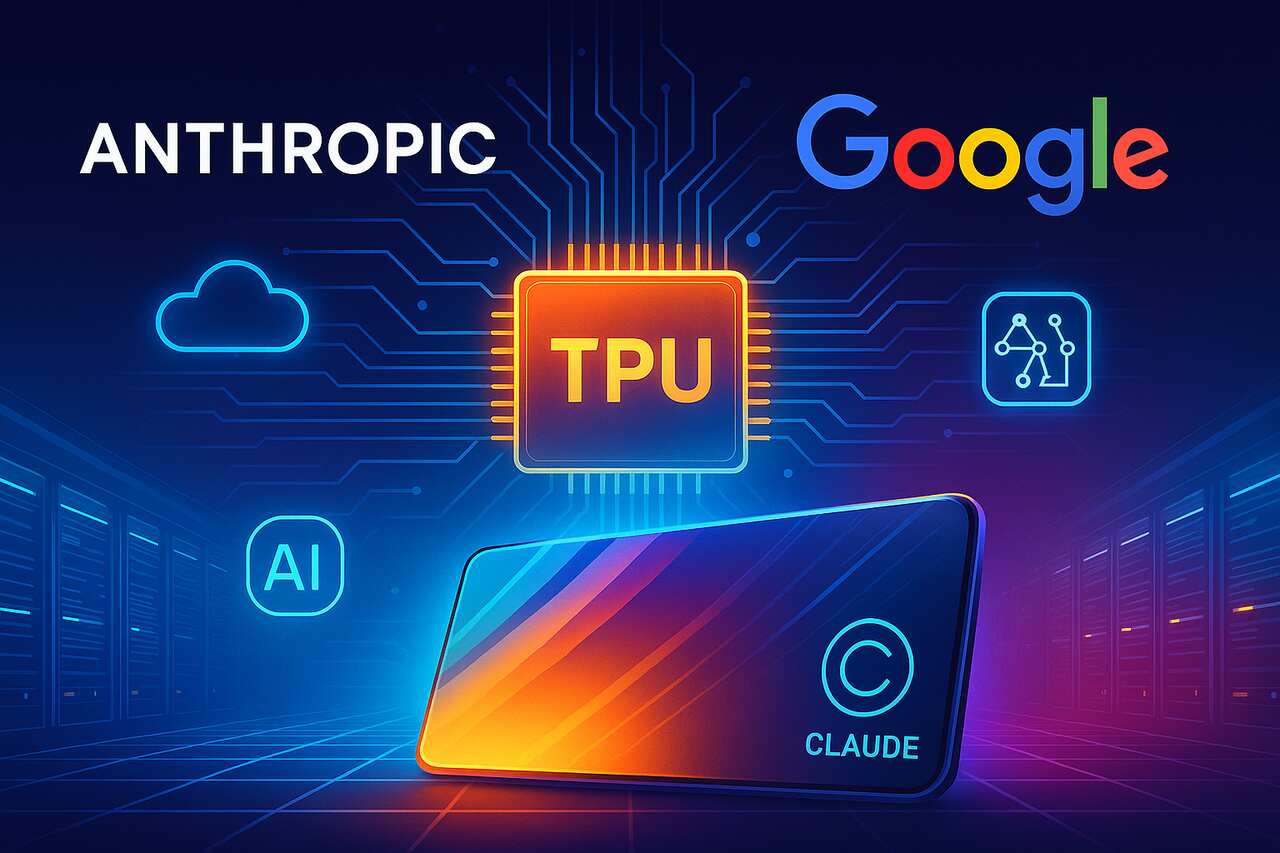
Anthropic is taking a bold step in reshaping the landscape of enterprise artificial intelligence. The company announced this week that it will deploy up to one million Google Cloud TPUs (Tensor Processing Units) by 2026, a move valued in the tens of billions of dollars. The expansion represents one of the largest single infrastructure commitments ever made by an AI model developer — and it signals a broader strategic shift in how large-scale AI systems are built and deployed.
 MacKenzie Sigalos
A Gigawatt Leap in AI Capacity
Once fully operational, the initiative will deliver more than a gigawatt of computing capacity, positioning Anthropic at the forefront of high-performance AI infrastructure. The scale of the deal underscores how rapidly enterprise adoption of AI is accelerating. Anthropic now serves over 300,000 business clients, with large accounts — those generating more than $100,000 in annual recurring revenue — growing nearly sevenfold over the past year.
This growth, driven by both Fortune 500 corporations and AI-native startups, reflects a turning point for Anthropic’s Claude models. What began as experimental deployments has evolved into enterprise-grade adoption, where reliability, cost control, and consistent performance are essential.
A Multi-Cloud, Multi-Chip Strategy
Unlike many of its competitors, Anthropic is not betting on a single cloud or chip platform. The company’s infrastructure spans three major technologies — Google’s TPUs, Amazon’s Trainium, and NVIDIA’s GPUs. This multi-cloud approach, according to Anthropic CFO Krishna Rao, is central to its long-term strategy.
Amazon remains Anthropic’s primary training and cloud partner through Project Rainier, a vast compute network spanning hundreds of thousands of AI chips across U.S. data centers. However, by deepening its collaboration with Google, Anthropic is diversifying its compute base — a move that mitigates vendor lock-in risks and enhances flexibility.
Kirsteen Rodger
For CIOs and CTOs charting their own AI roadmaps, the takeaway is clear: relying on a single infrastructure provider may be risky as AI workloads grow more complex. Different stages of AI development — from training massive models to fine-tuning, inference, and safety testing — demand different hardware capabilities, cost structures, and latency profiles.
The Economics of AI Compute
Google Cloud CEO Thomas Kurian highlighted that Anthropic’s choice reflects “strong price-performance and efficiency” demonstrated by TPUs. While specific metrics remain confidential, TPUs are engineered for tensor operations — the mathematical core of neural networks — making them more efficient for certain AI workloads than traditional GPUs.
The announcement also references “over a gigawatt of capacity,” a signal that power consumption and cooling are becoming major limiting factors in AI scaling. For enterprises managing their own infrastructure or negotiating data center contracts, understanding total cost of ownership — including power, space, and operations — is now just as important as raw compute pricing.
Google’s latest TPU generation, known as Ironwood, represents nearly a decade of engineering refinement. Its maturity, along with Google’s supply chain stability and tooling ecosystem, provides assurance for enterprise buyers wary of newer, less-tested hardware entrants.
What It Means for Enterprise AI Strategy
Anthropic’s decision carries several lessons for organizations planning long-term AI investments:
- Capacity and Continuity: The scale of Anthropic’s infrastructure expansion shows the capital intensity required to meet enterprise AI demand. Companies relying on external AI models should monitor providers’ capacity plans to avoid service bottlenecks during surging demand or supply chain disruptions.
- Safety and Alignment: Anthropic links the deal to expanding research in model safety and responsible deployment. For regulated sectors like finance, healthcare, and government, this focus directly impacts compliance and reliability standards.
- Ecosystem Integration: As AI applications increasingly run across multiple cloud environments — from AWS to Azure and beyond — enterprises must understand how their model providers’ infrastructure choices affect latency, availability, and certification requirements globally.
The Competitive Landscape
Anthropic’s billion-dollar TPU deal comes amid fierce competition from OpenAI, Meta, and other leading AI developers racing to secure compute capacity. For enterprise clients, this arms race may yield faster model improvements and better performance — but it also demands careful vendor management as partnerships and pricing evolve.
The broader lesson is one of pragmatism. Anthropic’s diversified infrastructure approach — blending TPUs, Trainium, and GPUs — signals that no single architecture yet dominates the enterprise AI market. For technology leaders, flexibility remains the smartest long-term strategy in an environment defined by rapid change.



