
A rare Pokémon card has just rewritten the record books.
A.J. Scaramucci, son of SkyBridge Capital founder and former White House communications director Anthony Scaramucci, has purchased a PSA 10 Pikachu Illustrator card from Logan Paul for $16.49 million. The sale marks the highest price ever paid for a trading card.
It is absolutely disgusting that Logan Pauls card that he sold 51% of to his fans for $2.5 million has hit such an insane price
— Kavos (@KavosYT) February 16, 2026
Logan took full ownership back without any of the shareholders permission because the company he co founded "liquid marketplace" are under… https://t.co/Mri3ULD2ja
The previous record stood at $13 million for a Michael Jordan–Kobe Bryant Dual Logoman 1/1 card sold in August. With this latest transaction, the world of high-end collectibles has reached a new milestone.
Why This Pokémon Card Is So Valuable
The Pikachu Illustrator card was released in 1998 as part of a Japanese illustration contest. Only 39 copies were officially distributed. According to grading records, this particular card is believed to be the only one to receive a PSA 10 grade, meaning it is considered virtually flawless, with sharp corners, clean surfaces, and no visible defects.
That rarity has made it one of the most sought-after Pokémon cards in existence. Paul originally purchased it in July 2021 for $5.3 million, at the time calling it a centerpiece of his collection.
For A.J. Scaramucci, the purchase appears to be part of a broader collecting ambition. Speaking to collectibles reporter Ben Burrows, he described himself as being on a “planetary treasure hunt,” adding that he aims to acquire a T-Rex fossil and even the Declaration of Independence.
AJ Scaramucci announces he's the buyer of the Pikachu Illustrator on Logan Paul's livestream.
— Ben Burrows (@BenMBurrows) February 16, 2026
Scaramucci is a co-founder of investment firm Solari Capital.
Adds the purchase is part of a treasure hunt, which he promotes with a website called Treasure Trove.
"I'm on a… https://t.co/6cb7NbdxqK
The Tokenization Controversy
The sale has drawn attention not just for its price but also for the card’s history in the crypto space.
After acquiring the Illustrator card, Paul raised roughly $8 million to launch Liquid Marketplace, a platform designed to tokenize physical and digital collectibles. In 2022, the Pokémon card was listed on the platform, and Paul offered up to 51% of it for fractional ownership. Ultimately, about 5.4% was sold to investors for approximately $270,000.
What an epic night. I’m truly grateful for the Pokémon community, Ken Goldin, and my team for making last night a historic moment for the hobby.
— Logan Paul (@LoganPaul) February 16, 2026
To address concerns regarding the ownership history of the card, now for the facts:
I had originally offered to sell up to 51% of the…
In 2024, however, the Ontario Securities Commission charged Liquid Marketplace, along with Paul and others, with alleged securities law violations. The accusations include failing to properly register, misleading investors, and misuse of funds. The case remains a point of scrutiny within the crypto community.
Paul has publicly addressed the situation. In a statement posted on X, he said he repurchased the card in May 2024 at the same valuation terms under which it was fractionally sold. He added that funds were made available to investors for withdrawal and that many did withdraw their money. After the platform later went offline, Paul stated that he personally paid to restore the website so users could access and retrieve remaining funds.
The controversy has not stopped interest in tokenized collectibles more broadly.
Pokémon Cards and the NFT Revival
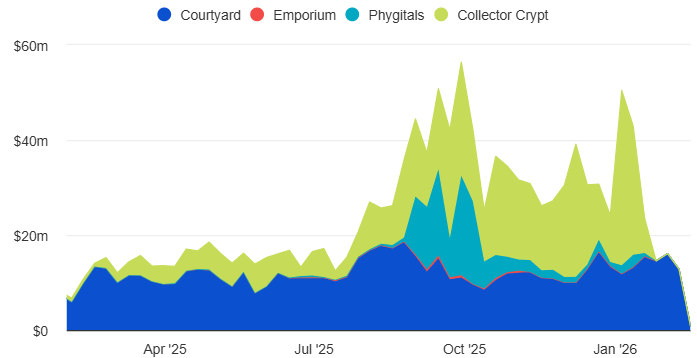
Interest in Pokémon cards continues to intersect with blockchain technology. Collector Crypt, a Solana-based trading card marketplace that tokenizes graded Pokémon cards into redeemable NFTs, recently reported nearly $37 million in trading volume during the first full week of January — its highest weekly total to date.
The surge suggests that while regulatory questions persist, the blending of traditional collectibles and digital ownership models remains active.
A Record Sale at the Crossroads of Collecting and Crypto
At $16.49 million, the Pikachu Illustrator now holds the title as the most expensive trading card ever sold. The deal highlights both the growing appetite for ultra-rare collectibles and the complicated relationship between high-value physical assets and blockchain-based ownership models.
For collectors, it reinforces the idea that rare items can rival fine art in price and prestige. For the crypto world, it serves as a reminder that innovation often moves faster than regulation.
Either way, this latest sale shows that the market for rare treasures — whether physical, digital, or somewhere in between — is far from slowing down.



