

Ant Group has entered the trillion-parameter AI model race with the launch of Ling-1T, an open-source language model designed to push the boundaries of reasoning performance while maintaining computational efficiency. Announced on October 9, the move marks a major milestone for the Alipay operator as it expands its artificial intelligence portfolio across multiple model architectures.
A New Benchmark in AI Reasoning
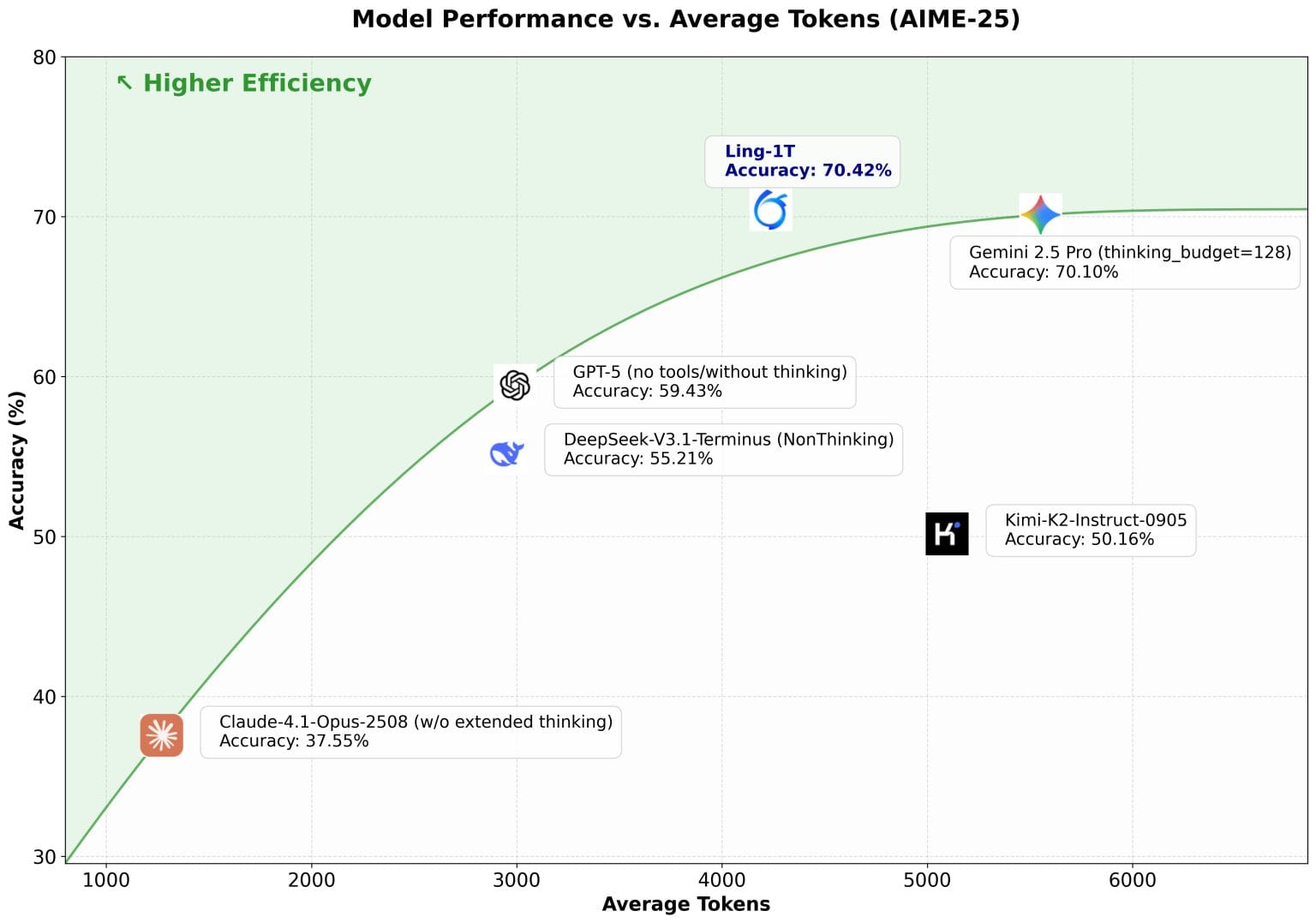
The trillion-parameter Ling-1T model achieved an impressive 70.42% accuracy on the 2025 American Invitational Mathematics Examination (AIME) benchmark—a key test for evaluating AI problem-solving skills. According to Ant Group’s technical documentation, Ling-1T maintains this level of performance while processing more than 4,000 output tokens per problem, placing it among what the company calls “best-in-class” AI systems.
Dual Release Strategy: Ling-1T and dInfer
Coinciding with Ling-1T’s debut, Ant Group also unveiled dInfer, a specialized inference framework built for diffusion language models (dLLMs). The dual release reflects Ant’s broader bet on exploring multiple technological frontiers rather than relying on a single model architecture.
Unlike traditional autoregressive models—which generate text sequentially, as seen in tools like ChatGPT—diffusion models generate outputs in parallel. This method, already proven effective in image and video generation, could potentially transform how AI handles text.
In internal benchmarks, Ant Group’s LLaDA-MoE diffusion model running on dInfer reached 1,011 tokens per second on the HumanEval coding test, outperforming Nvidia’s Fast-dLLM (91 tokens per second) and Alibaba’s Qwen-2.5-3B model on vLLM infrastructure (294 tokens per second).
Ant Group researchers said in accompanying notes that dInfer “offers both a practical toolkit and a standardized platform to accelerate research and development in the growing field of diffusion-based large language models.”
Expanding the AI Ecosystem
Ling-1T joins a growing family of AI systems under Ant Group’s expanding umbrella. The lineup now includes:
- Ling series: non-reasoning language models for general tasks.
- Ring series: reasoning models, including the earlier Ring-1T-preview.
- Ming series: multimodal models that integrate text, audio, image, and video processing.
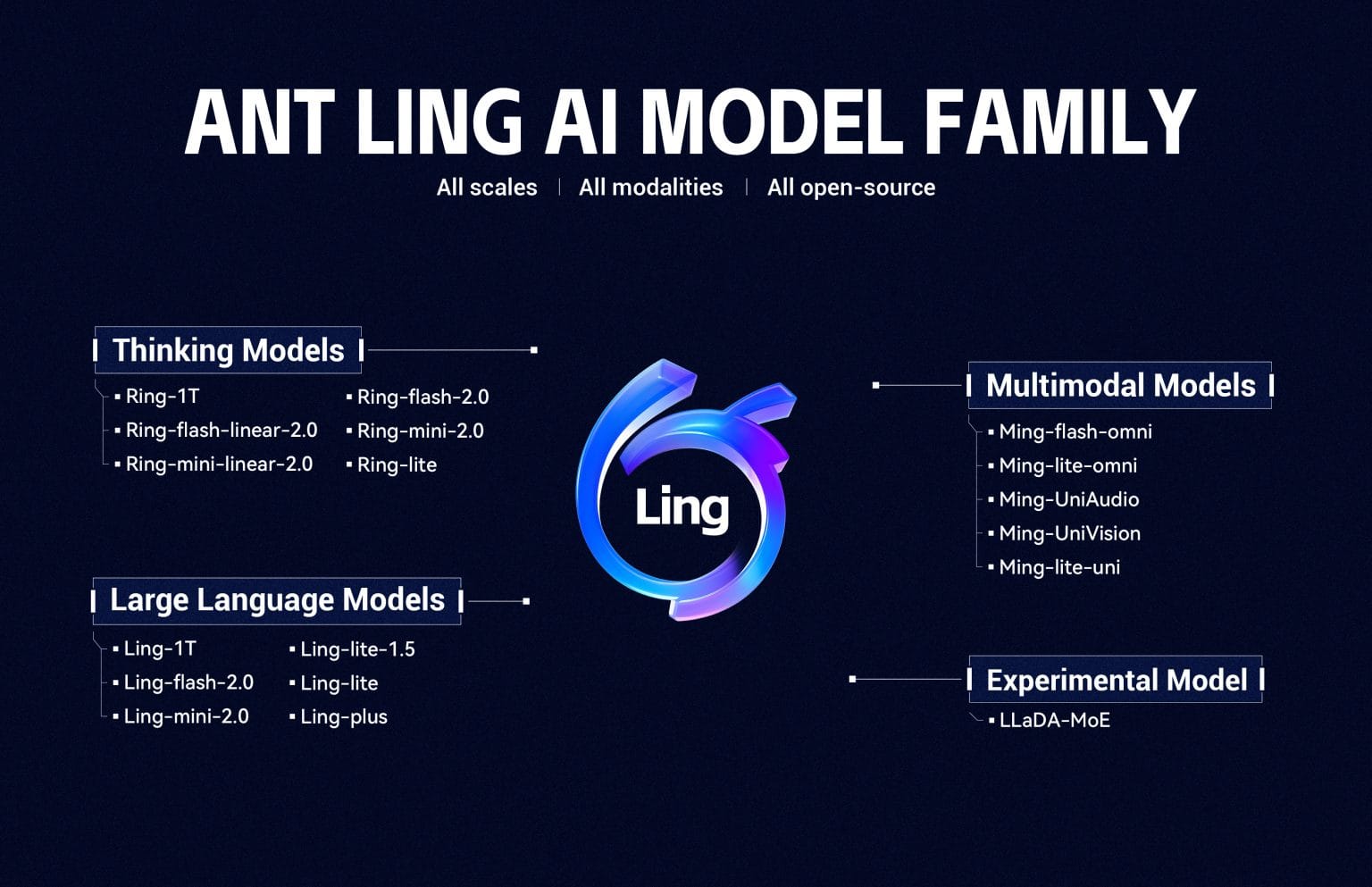
Ant Group is also testing LLaDA-MoE, a Mixture-of-Experts (MoE) model that activates only relevant portions of the network for specific tasks—an efficiency-boosting approach gaining traction in large-scale AI development.
A Push for Open and Collaborative AI
He Zhengyu, Ant Group’s Chief Technology Officer, emphasized the company’s philosophy of openness.
“At Ant Group, we believe Artificial General Intelligence (AGI) should be a public good—a shared milestone for humanity’s intelligent future,” He said, adding that open-sourcing Ling-1T and Ring-1T-preview represents a step toward “open and collaborative advancement.”
This approach contrasts with the closed, proprietary strategies of some global competitors and positions Ant Group’s technologies as potential building blocks for the broader AI community.
Competing Under Constraints
Ant Group’s timing also reflects a strategic pivot within China’s AI sector. With access to advanced semiconductor technology limited by export controls, many Chinese firms—including ByteDance, which launched its Seed Diffusion Preview model in July—are focusing on algorithmic innovation and software optimization to stay competitive.
While diffusion-based systems promise faster and more efficient output generation, their real-world adoption is still uncertain. Autoregressive models continue to dominate commercial applications due to their maturity and proven capabilities in natural language understanding.
Looking Ahead
Ant Group’s open-source strategy may help validate its trillion-parameter model through community testing and adoption, potentially establishing the company as a serious global contender in AI research. The group is also developing AWorld, a framework aimed at continuous learning for autonomous AI agents capable of completing tasks independently.
Whether Ant Group can parlay these innovations into global influence will depend on how well developers, researchers, and businesses embrace its open platforms. For now, the Ling-1T and dInfer launches signal a bold, forward-looking move in an AI landscape that’s rapidly evolving—and still wide open for new leaders.



