

Amundi has launched a $100 million tokenized fund across two blockchains. The move reinforces institutional adoption of tokenized real-world assets (RWA) as infrastructure shifts toward onchain settlement.
The Spiko Amundi Overnight Swap Fund (SAFO) uses Chainlink for automated NAV reporting & secure cross-chain interop.
— Chainlink (@chainlink) March 19, 2026
SAFO features an EU‑regulated UCITS structure backed by fully collateralized total return swaps, launching with $100M in committed AUM: https://t.co/q7G6VvqCw1 pic.twitter.com/HxOE3eYNPl
The Amundi fund, named Spiko Amundi Overnight Swap Fund (SAFO), operates on Ethereum and Stellar. Structured as a sub-fund of SPIKO SICAV under French regulation, it targets treasury and collateral management use cases for institutional investors, offering subscriptions and redemptions in EUR, USD, GBP, and CHF.
 Amundi
Can Tokenized Funds Scale Institutional Liquidity Onchain?
SAFO provides fully collateralized total return swaps with banking counterparties to maintain overnight liquidity. The structure enables near-instant settlement, continuous transferability, and real-time transparency of fund ownership, with access delivered through APIs and smart contracts. CACEIS acts as depositary, while Chainlink records net asset value data onchain.
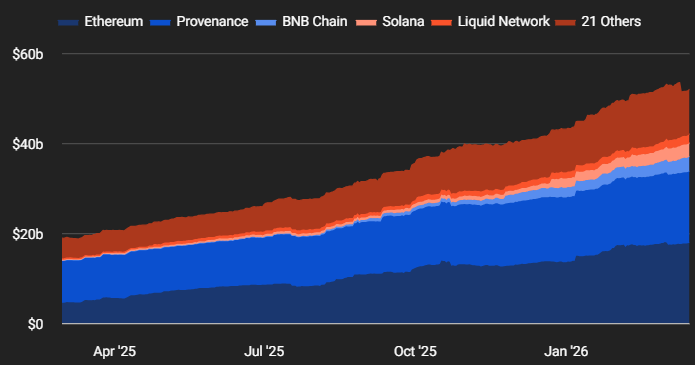
The launch follows Amundi’s earlier tokenized issuance on Ethereum in November, indicating a measured expansion strategy rather than a one-off pilot. The broader RWA market has grown to nearly $52 billion, up from $15.2 billion at the start of 2025, according to data. Ethereum leads with $17.85 billion in tokenized assets, highlighting its dominance in institutional deployments.
“SAFO provides professional investors with a fast and transparent access to cash management solutions,” said Jean-Jacques Barbéris.
He added that the initiative aligns with the firm’s broader strategy to expand tokenized financial products.
Still, scaling tokenized funds will depend on distribution, regulatory clarity, and interoperability across platforms. Market participants will watch whether expanded API access and cross-chain issuance drive secondary market activity and deeper institutional allocation into tokenized instruments.



