

American Bitcoin has increased its treasury to 6,899 BTC, surpassing Galaxy Digital and ranking 16th among public Bitcoin-holding companies. The rapid accumulation highlights a growing trend of corporate mining strategies aimed at building reserves below market prices.
The company disclosed the updated figure on Wednesday, up from roughly 6,500 BTC reported two weeks earlier. At a Bitcoin price near $71,000, the holdings are valued at approximately $492 million. Eric Trump, co-founder and chief strategy officer, said the firm is “climbing the ladder faster” than peers in public treasury rankings.
Proud to announce that as of minutes ago, American Bitcoin (@ABTC) has passed Galaxy Digital in BTC holdings!
— Eric Trump (@EricTrump) March 18, 2026
We now stand as the #16th largest Public Bitcoin Company on Earth!
No company is climbing the ladder faster
Up, up, up we go! 🚀🇺🇸💪 pic.twitter.com/7QSLho0U3Z
Can Mining Strategies Outpace Direct Bitcoin Buying?
American Bitcoin’s approach differs from firms that acquire Bitcoin directly through open markets. The company has focused on scaling mining operations, recently adding 11,298 ASIC machines to expand production capacity. This allows it to accumulate Bitcoin at potentially lower effective costs, depending on energy and operational efficiency.
By comparison, other corporate holders such as Trump Media & Technology Group hold around 9,500 BTC, placing them higher in treasury rankings, according to Bitcoin Treasuries data. Still, mining-led accumulation introduces different risk dynamics, including exposure to energy prices, hardware costs, and network difficulty adjustments.
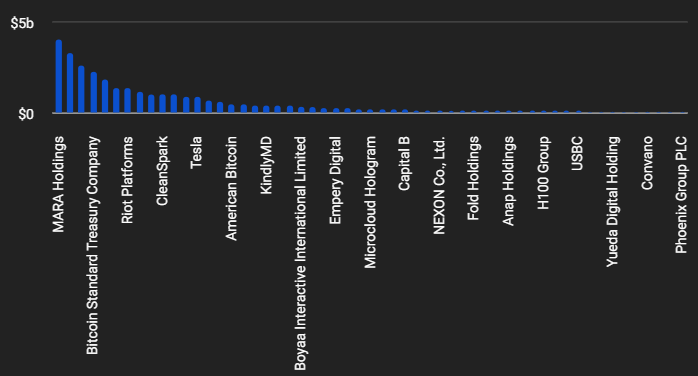
The company was launched in March 2025 as a majority-owned subsidiary of Hut 8, in partnership with American Data Centers. Eric Trump said the firm’s growth reflects a deliberate strategy to build a strategic reserve through industrial-scale mining rather than relying solely on market purchases.
Yet, the pace of accumulation raises questions about sustainability as mining competition intensifies. Will expanding hash rate and rising operational costs limit the effectiveness of this strategy over time? Future disclosures on production output and cost basis will provide clearer signals as the company continues scaling its infrastructure.



