

American Bitcoin will increase its owned hashrate to approximately 28.1 exahash per second following the purchase of 11,298 additional ASIC miners. The expansion represents an anticipated 12% increase in capacity as the company doubles down on a scaled self-mining strategy.
The newly acquired machines add about 3.05 EH/s at an efficiency of roughly 13.5 joules per terahash, bringing the total owned fleet to 89,242 miners at an average efficiency of 16 J/TH. Delivery and deployment are expected in March 2026 at the company’s Drumheller site in Alberta, with operational capacity projected at around 25 EH/s once energized.
Can Accumulation Outperform AI Diversification?
American Bitcoin defines its owned fleet as all miners and associated hashrate it controls, including units not yet operational. The largest publicly traded bitcoin miners currently maintain around 50 EH/s of capacity, placing American Bitcoin below industry leaders but within the upper tier of scaled operators.
The company’s strategy centers on accumulating bitcoin below spot market prices rather than monetizing holdings to fund artificial intelligence pivots. It reported mining bitcoin at a 53% discount to spot prices in the fourth quarter of 2025 and ended the year with 5,401 BTC on its balance sheet, later growing that figure to more than 6,000 BTC. By contrast, several peers have begun liquidating treasury holdings to finance data center expansions into AI and high-performance computing.
“As Bitcoin matures, the priority is clear: grow American-owned, professionally operated hashrate,” said Eric Trump, co-founder and chief strategy officer.
 American Bitcoin Corp.
President Matt Prusak added that every capital decision is oriented around maximizing bitcoin accumulation, reinforcing a treasury-first approach despite market volatility.
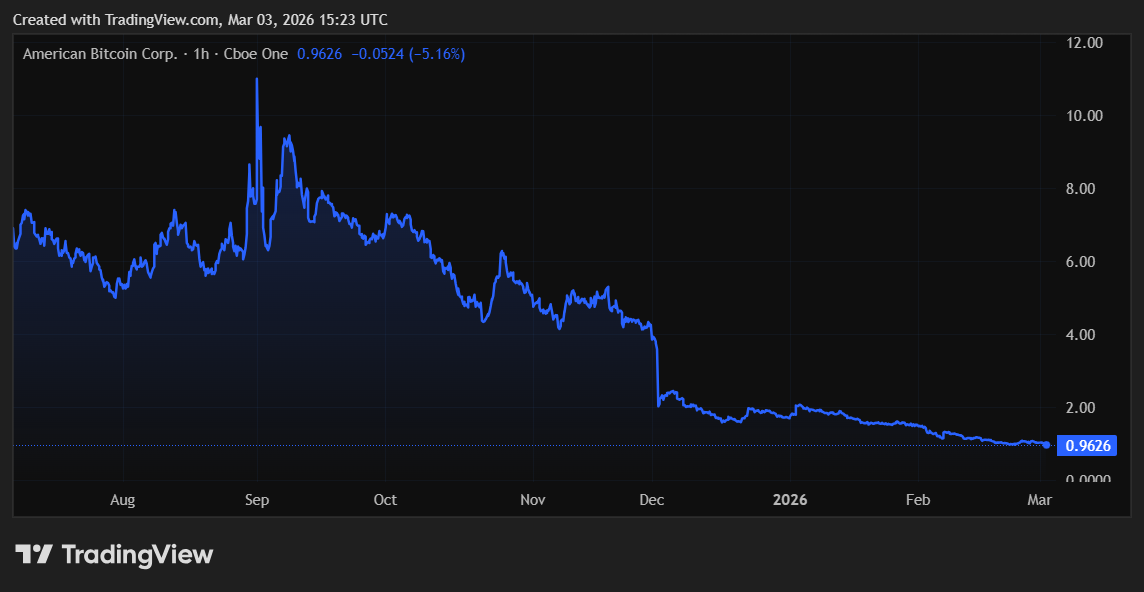
Financial results reflect the accounting impact of that strategy. For 2025, the company posted $185.2 million in revenue and a net loss of $153.2 million, driven largely by a $227.1 million non-cash mark-to-market loss on bitcoin holdings. With shares down 41.7% year-to-date, investors will monitor whether expanded capacity translates into higher bitcoin per share as network difficulty and price conditions evolve.



