
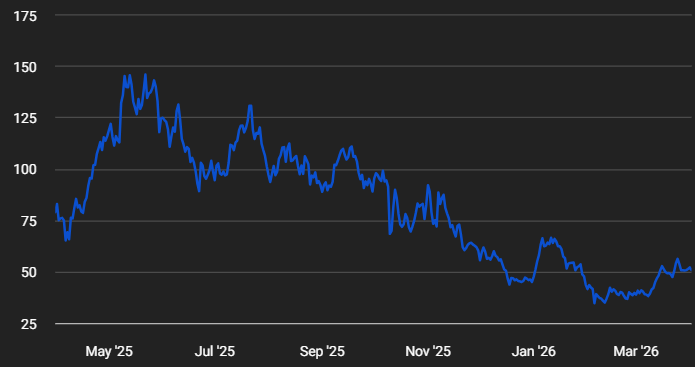
The GMCI AI Index rose 48% since February, reaching 51.26 on Sunday. The move signals renewed capital concentration in a narrow set of AI-linked crypto assets.
Yet the index remains 84% below its first-quarter 2024 peak, highlighting the depth of the prior drawdown. Its composition is heavily skewed, with Bittensor (TAO), Render (RNDR), and Artificial Superintelligence Alliance (ASI) accounting for more than 71% of weight.
Is Bittensor Driving The AI Token Rally?
Data from shows TAO nearly doubled in March, contributing the majority of index gains due to its 24.89% weighting. The rally coincides with a technical milestone inside the Bittensor network, where Subnet 3 introduced Covenant-72B, a 72-billion-parameter language model trained across more than 70 distributed nodes.
The model achieved a 67.1 score on the MMLU benchmark, placing it within range of centralized systems such as Meta’s Llama 2 70B. Still, the index’s narrow construction suggests the rally reflects performance of a few large-cap infrastructure tokens rather than broad-based AI crypto demand.
Market participants increasingly view this development as a proof point for distributed training, long criticized as inefficient and fragmented. Recognition from figures including Nvidia CEO Jensen Huang and investor Chamath Palihapitiya added narrative momentum to the ecosystem.
Beyond Subnet 3, activity across the network is expanding into commercial use cases. Targon (SN4), a decentralized GPU marketplace operated by Manifold Labs, secured a six-figure agreement to support Dippy AI’s backend, which serves 8.6 million users.
With over 10.7 million TAO issued and more than 68% staked, supply dynamics remain tight relative to circulating liquidity. The next catalyst will likely hinge on whether additional subnets can replicate Covenant-72B’s performance at scale while sustaining enterprise demand.



