

Aave now secures roughly $23.8 billion in total value locked (TVL), and its expansion to OKX’s Layer 2 network extends that liquidity to a new user base. The integration matters because it removes friction between centralized exchange wallets and decentralized lending, tightening the loop between custody and yield generation.
OKX announced Monday that Aave has gone live on X Layer, its Ethereum-based Layer 2 network. The deployment allows OKX Wallet users to supply assets, borrow against collateral, and earn compounding yield without bridging or configuring external wallets. Supported assets include USDT0, USDG, GHO, and wrapped tokens such as xBTC and xETH.
Onchain capital without the friction: @Aave is live on X Layer inside @Wallet
— OKX (@okx) March 30, 2026
Supply assets, borrow against collateral & earn yield with 6 dedicated eModes offering up to 88% LTV.
No bridging, fragmented workflows, or trade-offs on control.
Details: https://t.co/Smujp1DBY5 pic.twitter.com/QIDVCuhib5
Does Native Wallet Access Change DeFi Adoption?
Centralized exchanges have increasingly embedded decentralized finance tools directly into their ecosystems to retain user flow. Coinbase integrated DeFi access through Base, while Binance expanded wallet-linked services, signaling a broader shift toward hybrid CeFi-DeFi models. But OKX’s direct Aave integration removes an additional onboarding step that still exists on competing platforms.
“Aave’s arrival on X Layer brings battle-tested infrastructure directly into the OKX Wallet environment,” the company said in a blog post.
Stani Kulechov, founder of Aave Labs, added that the move connects Aave’s liquidity to a growing network of users and applications, enabling borrowing and yield generation without intermediaries. The protocol remains non-custodial, with users retaining control of their assets.
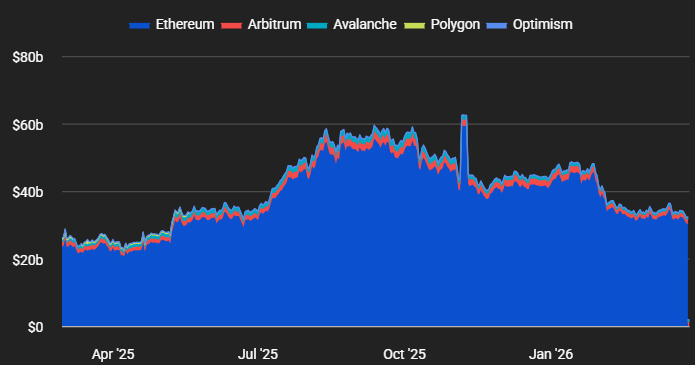
X Layer introduces six efficiency modes, or eModes, calibrated for its asset pairs, allowing up to 88% loan-to-value ratios on certain liquid staking assets. That parameter signals an attempt to optimize capital efficiency while managing liquidation risk within a controlled asset set.
Still, the next catalyst will hinge on whether wallet-native DeFi access translates into sustained borrowing demand and deeper liquidity across X Layer’s ecosystem.



