
The El Salvadorian legislative assembly just made a major, and controversial, move, voting to eliminate presidential term limits. This bold reform, passed 57-3, means President Nayib Bukele, who already enjoys incredibly high approval ratings, can now seek re-election indefinitely. While this has drawn sharp criticism from human rights groups and international observers, for the crypto community, it raises a different, but equally important, question: what does this mean for the country’s landmark Bitcoin policy?
Bukele is literally the most popular democratically-elected leader in the world.
— Geiger Capital (@Geiger_Capital) August 1, 2025
He took El Salvador from the murder capital of the world to the safest country in the Western hemisphere.
When you get a once-in-a-century leader, you let him keep running for reelection. pic.twitter.com/o0Khu5aNjD
Bukele’s extended grip on power signals a continuation of his Bitcoin-centric economic vision, a strategy he's been championing since making BTC legal tender in 2021. Despite pressure from institutions like the International Monetary Fund (IMF), his administration has consistently positioned El Salvador as a nation actively accumulating Bitcoin.
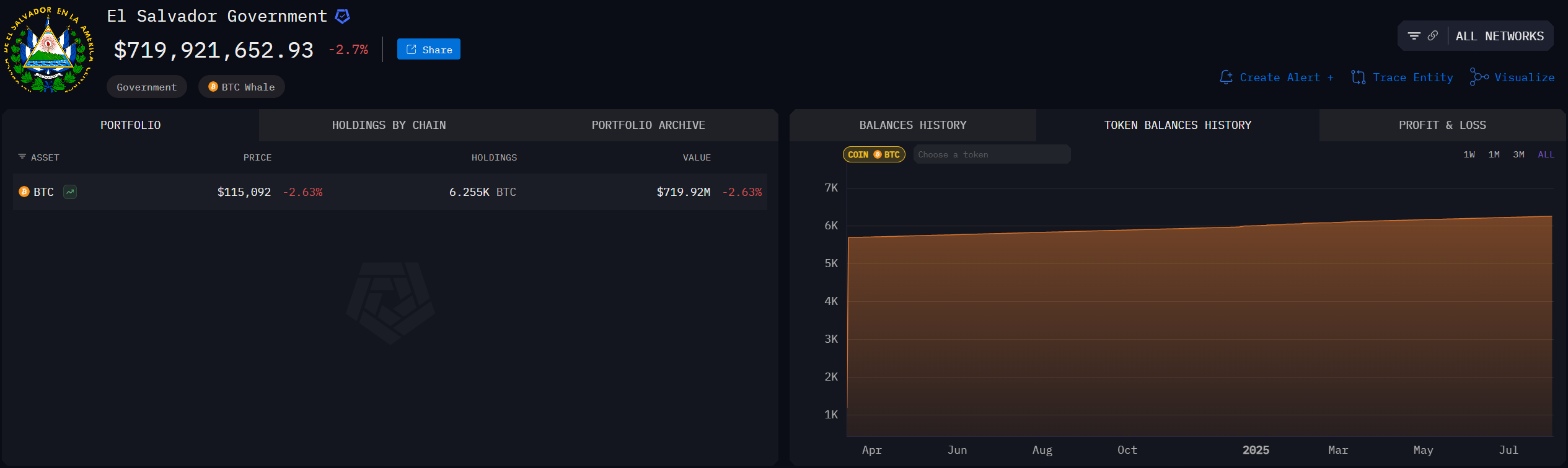
In late July, for instance, the government announced a new purchase of eight BTC, bringing their total reported holdings to approximately 6,248 BTC, valued at over $740 million. On-chain data from Arkham Intelligence seems to corroborate this, showing a holding of 6,255 BTC.
EL SALVADOR JUST BOUGHT MORE BITCOIN
— The Bitcoin Office (@bitcoinofficesv) July 24, 2025
🇸🇻🚀 pic.twitter.com/H5rbVvrodH
The Problem with the Public Narrative
However, a closer look at the data—and a recent IMF report—reveals a more complicated story. The IMF report, which came out as part of a review for a $1.4 billion credit program, explicitly states that El Salvador has not made any new Bitcoin purchases. A footnote in the report clarifies that what the government has been presenting as new acquisitions are, in fact, internal wallet transfers.
This revelation has sparked a flurry of questions about transparency. As on-chain analysts are quick to point out, the government’s public announcements about "stacking" more Bitcoin seem to contradict the on-chain reality.
John Dennehy, founder of the Bitcoin education project "My First Bitcoin," has been a vocal critic of this discrepancy. He wrote in a recent post: "Another day, another Bitcoin transferred from an undisclosed govt controlled wallet to a public facing govt controlled wallet It’s misleading to present this as El Salvador stacking when in reality the total amount stays the same."
This suggests that, to secure a crucial loan, El Salvador made an agreement with the IMF to halt further Bitcoin purchases, but has been maintaining the public perception of a continuing accumulation strategy by shuffling coins between government wallets.
What Lies Ahead for El Salvador’s Bitcoin Vision?
The legislative reforms were passed with minimal opposition, solidifying the perception of Bukele's momentum and political stability. This continuity could be seen as a positive by investors and developers, potentially enabling long-term blockchain infrastructure and favorable regulations. The country has also been expanding its influence in the region, recently signing a crypto agreement with Bolivia.
Ultimately, the question for the global crypto community is whether El Salvador's Bitcoin path is driven by a genuine, long-term economic vision or is primarily a political statement. While Bukele's renewed mandate gives him the power to act decisively, many are still looking for concrete proof that the government's on-chain actions align with its bold, pro-Bitcoin narrative. The market is now watching closely to see if the substance can match the symbolism.



